Hi, Continue visiting your profile
user

Login

Email

Password

Create account
Forget password
AnyGenes
  • email login

Innate lymphoid cells: functions, mechanisms and gene expression analysis

Innate lymphoid cells, or ILCs, are immune cells that contribute to tissue protection, inflammation control, barrier immunity and repair mechanisms. Unlike T and B lymphocytes, ILCs do not rely on antigen-specific receptors, but they can respond rapidly to local tissue signals and cytokines.

Because ILCs are involved in immune regulation, inflammatory responses and tissue remodeling, they are increasingly studied in immunology, respiratory disease, mucosal immunity, cancer research and biomarker discovery. Understanding their gene expression profiles can help researchers explore how immune pathways are activated, regulated or dysregulated in different biological contexts.

What are innate lymphoid cells?

Innate lymphoid cells are a family of immune cells involved in early immune responses and tissue homeostasis. They are mainly found at barrier surfaces such as the lung, gut and skin, where they help coordinate local responses to infection, tissue damage, allergens and inflammatory signals.

ILCs are functionally related to T helper cell responses, but they act through innate immune mechanisms. Their classification is based on key transcription factors and cytokine profiles, which define three major groups: ILC1, ILC2 and ILC3.

You can study involvement of Innate Lymphoid Cells in many processes like protective immunity, tissue remodeling, regulation of homeostasis and inflammation by using our qPCR SignArrays.

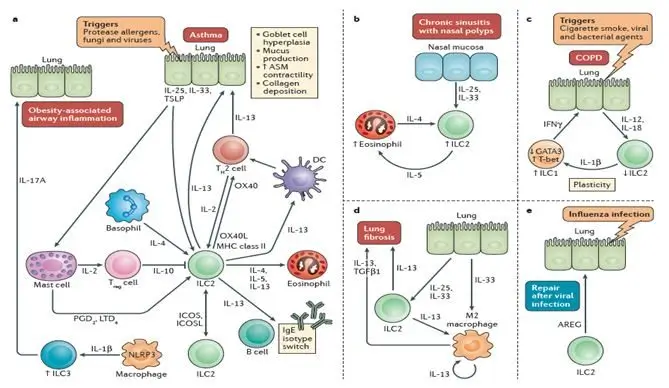
Ebbo M. et al, Nat Rev. Immunol. 2017 / Figure 2 | Innate lymphoid cells are involved in various airway inflammatory disorders. a) In airway hyper-responsiveness and allergic asthma, b) In chronic rhinosinusitis with nasal polyps , c) In chronic obstructive pulmonary disease (COPD) d) In a murine bleomycin-induced lung fibrosis model, e) In a mouse model of H1N1 influenza virus infection.

Main innate lymphoid cell groups

Innate lymphoid cells are commonly classified into three major groups according to their immune response profile, cytokine production and biological functions.

Main innate lymphoid cell groups, immune response types, associated mediators and biological relevance.
ILC group Main immune response Commonly associated mediators Biological relevance
ILC1 Type 1 immunity IFN-γ, TNF-related responses Antiviral defense, intracellular pathogens and inflammatory signaling.
ILC2 Type 2 immunity IL-5, IL-13, amphiregulin-related responses Allergy, asthma, tissue repair and airway inflammation.
ILC3 Type 3 immunity IL-17, IL-22-related responses Mucosal defense, epithelial barrier regulation and intestinal inflammation.

These groups help describe ILC biology, but ILC populations may show functional adaptation or plasticity depending on the tissue environment and inflammatory context.

ILCs in inflammation and disease mechanisms

Innate lymphoid cells are important in maintaining immune balance. When properly regulated, they support protective immunity, epithelial barrier integrity and tissue repair. When dysregulated, they may contribute to chronic inflammation and disease-associated immune responses.

ILC2 cells have been widely studied in airway inflammation, allergic asthma and chronic rhinosinusitis with nasal polyps. ILC1 and ILC3 populations are also investigated in chronic inflammatory settings, including respiratory and intestinal diseases. In these contexts, researchers often study cytokine expression, transcriptional regulators and pathway-specific gene signatures to better understand immune activation.

ILC plasticity and transcriptional regulation

One of the most important aspects of ILC biology is plasticity. ILC subsets may adapt their phenotype in response to cytokines, tissue-derived signals, infection, inflammation or environmental stress. This plasticity can influence disease progression and may explain why ILC-associated signatures differ between tissues, patients or experimental models.

Studying transcriptional regulation is therefore essential. Genes involved in cytokine signaling, transcription factor activity, immune activation and tissue repair can provide useful information about ILC state and function.

Why study innate lymphoid cells with gene expression analysis?

Gene expression analysis helps researchers investigate immune pathway activity at the molecular level. In ILC-related studies, qPCR and qPCR arrays can be used to measure selected genes involved in:

  • ILC subset identity
  • Cytokine signaling
  • Inflammatory pathway activation
  • Tissue repair and remodeling
  • Immune checkpoint and immune regulation mechanisms
  • Biomarker candidate validation
  • Pathway-focused immune profiling

Compared with broad discovery methods, targeted qPCR analysis is useful when researchers need to focus on selected pathways, validate candidate genes or compare immune signatures across multiple samples.

How qPCR SignArrays® can support ILC-related research

AnyGenes® qPCR SignArrays® are designed to support targeted gene expression analysis in defined biological pathways. For researchers studying innate lymphoid cells, inflammation or immune signaling, pathway-focused qPCR arrays can help evaluate selected genes involved in immune activation, cytokine responses and disease-associated signaling.

This approach can be useful when studying:

  • Respiratory inflammation
  • Airway immune responses
  • Chronic inflammatory diseases
  • Immune regulation and tissue homeostasis
  • Biomarker discovery in immunology
  • Validation of transcriptomic findings from RNA-seq or other discovery approaches

By focusing on biologically relevant gene panels, qPCR arrays help researchers obtain interpretable expression data adapted to their scientific question.

Related AnyGenes® solutions

Explore AnyGenes® solutions for immune pathway and biomarker-focused gene expression analysis:
  • qPCR arrays for immune signaling pathways
  • Immune checkpoint inhibitor biomarker analysis by gene expression
  • qPCR SignArrays® for pathway-focused transcript profiling
  • RNA-seq validation with targeted qPCR arrays

Scientific references

  1. Ebbo M. et al. Innate lymphoid cells: major players in inflammatory diseases. Nat. Rev. Immunol. (2017) 17(11):665-678. doi: 10.1038/nri.2017.86.
  2. Gronke K. et al. Innate lymphoid cells, precursors and plasticity. Immunol. Lett. (2016) 179:9-18. doi : 10.1016/j.imlet.2016.07.004.
  3. Bal S.M. et al. IL 1β, IL 4 and IL 12 control the fate of group 2 innate lymphoid cells in human airway inflammation in the lungs. ( Nat. Immunol. (2016) 17(6):636-645. doi:10.1038/ni.3444.
  4. Serafini N. et al. Transcriptional regulation of innate lymphoid cell fate. Nat. Rev. Immunol. (2015) 15(7):415-428. doi: 10.1038/nri3855.
  5. Spits H. et al. Innate lymphoid cells-a proposal for uniform nomenclature. Nat. Rev. Immunol. (2013) 13(2):145-149. doi: 10.1038/nri3365.