Hi, Continue visiting your profile
user

Login

Email

Password

Create account
Forget password
AnyGenes
  • email login

Caspase activation: key pathways and mechanisms

The caspase activation plays a critical role in programmed cell death (apoptosis), inflammation, and other cellular processes. This essential pathway ensures the removal of damaged or unnecessary cells, maintaining cellular homeostasis. Disruptions in caspase activity can lead to various diseases, including cancer, autoimmune disorders, and neurodegenerative conditions.

AnyGenes, with its innovative range of products, including specialized caspase assays and SignArrays® kits support research in this field by offering precise tools to study caspase activity and its regulation, helping scientists explore these critical pathways and their implication in health and disease.

Illustration of caspase activation in apoptosis, featuring AnyGenes' advanced tools for research and analysis.

Discover our advanced qPCR arrays for Caspase Activation research.

Explore the intricate caspase activation pathway and its critical role in programmed cell death, a fundamental process in maintaining cellular health
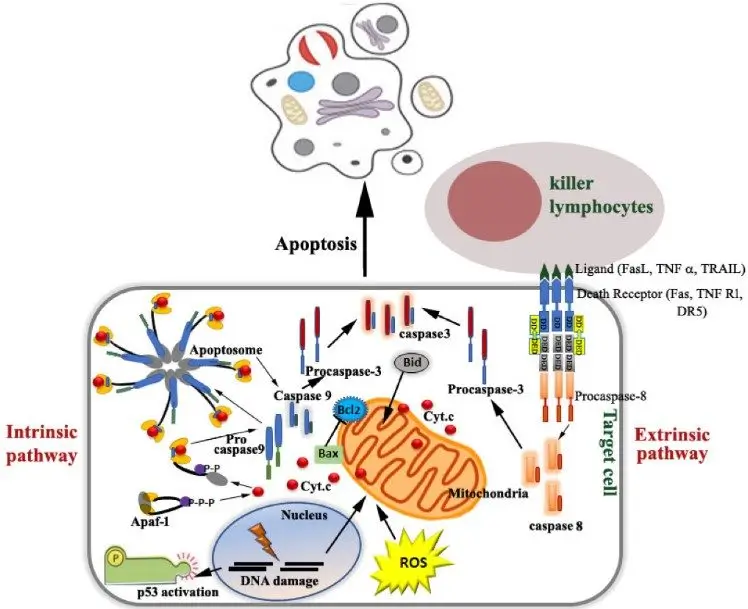
A schematic representation depicting the molecular pathways with the biomarkers of caspase-dependent programmed cell death: intrinsic and extrinsic pathways.

What are caspase ?

Caspases (Cysteine-aspartic proteases) are a family of protease enzymes that are essential for initiating and executing apoptosis. They exist as inactive proenzyme and are activated in response to specific cellular signals.

Caspases are broadly classified into two types based on their function:

  • Initiator caspases (caspase-2, caspase-8, caspase-9, caspase-10): These are responsible for the initiation of apoptosis by cleaving and activating executioner caspases.
  • Executioner caspases (caspase-3, caspase-6, caspase-7): These are responsible for the breakdown of key cellular components, leading to cell death.

Once caspases are activated, they begin a cascade that dismantles the cell: DNA fragmentationdegradation of cellular proteinmembrane blebbing, cell shrinkage and phagocytosis.

Pathways of caspase activation

Caspace activation occurs through two primary pathways:
  1. Intrinsic (mitochondrial) pathway: Triggered by internal signals, such as DNA damage, oxidative stress, or mitochondrial dysfunction. The release of cytochrome c from mitochondria leads to the formation of the apoptosome, activating initiator caspas-9. Caspase-9 then activates executioner caspases, leading to cell death.
  2. Extrinsic (death of receptors) pathway: Triggered by external signals, such as binding of FAS Ligand (FASL) to FAS receptors or TNF-α to TNF receptor on the cell surface. This interaction triggers the formation of the DISC, which activates initiator caspase-8 or caspase-10. These in turn activates executioner caspases or amplify the apoptotic signal by cleaving Bid, Bcl-2 family protein, to tigger the intrinsic pathway.

Caspase activation in diseases

Aberrant caspase activation or inhibition has been implicated in several diseases:

  • Cancer: Down regulation of caspase activity is associated with the uncontrolled proliferation of cells, promoting tumor growth.
  • Neurodegenerative disorders: Excessive activation of caspase contributes to neuronal death in diseases such as Alzheimer’s and Parkinson’s.
  • Autoimmunes disorders: Dysregulated caspase activity can result in chronic inflammation and tissus damage.

caspase activation and therapies

Ongoing research is exploring how manipulating activation of caspases can offer new therapeutic approaches. Caspase inhibitors, for instance, are being developed as potential treatments for neurodegenerative disorders, while activators of caspases are being investigated as anti-cancer therapies.

Analyze your pathway data with AnyGenes® software

Scientific data is only as powerful as the analysis behind it.

AnyGenes® provides a dedicated data analysis tool specifically developed for SignArrays® pathway panels.

What does it allow you to do?

  • Automated ΔCq calculation
  • Normalization with selected housekeeping genes
  • Comparison of up to 10 experimental conditions
  • Generation of descriptive statistics
  • Publication-ready graphs
  • Exportable tables for manuscripts and presentations

Developed on Excel (compatible with 2007+), the software is user-friendly and requires no advanced bioinformatics skills.

Customize your own signaling pathways (SignArrays®) with the factors of your choice!
Simply download and complete our Personalized SignArrays® information file and send it at [email protected] to initiate your project.

Caspase activation biomarker list

You can check the biomarker list included in this pathway, see below:

Looking for more answers? Visit our Help & FAQ section to find detailed informations about our products, services, and technical support.

Bibliography

1. Zhra M, et al. A Comprehensive Exploration of Caspase Detection Methods: From Classical Approaches to Cutting-Edge Innovations. Int J Mol Sci. (2024)17;25(10):5460.

2. Bhadra K. A schematic representation depicting the molecular pathways with the biomarkers of caspase-dependent programmed cell death: intrinsic and extrinsic pathways. Molecules. (2022)28;27(19):6401.

3. Parrish AB, Freel CD, Kornbluth S. Cellular Mechanisms Controlling Caspase Activation and Function. Cold Spring Harb Perspect Biol. (2013)1;5(6):a008672.

4. Guerrero AD, et al. Promotion of Caspase Activation by Caspase-9-mediated Feedback Amplification of Mitochondrial Damage. J Clin Cell Immunol. (2012)9;3(3):1000126.

5. Peterson QP, et al. Preparation of the Caspase-3/-7 substrate Ac-DEVD-pNA via Solution-Phase Peptide Synthesis. Nat Protoc. (2010); 5(2): 294–302.

Need pricing information or distributor details?
For quotations, product information, or project discussions, please contact our team at [email protected].