LncRNA RNA-seq validation helps confirm candidate long non-coding RNAs identified by transcriptomic analysis and supports more reliable biological interpretation.
Because many lncRNAs are weakly expressed, isoform-dependent or structurally complex, targeted qPCR validation is commonly used to verify selected RNA-seq findings with a sensitive and reproducible method.
This workflow is designed for researchers who need to confirm selected lncRNA candidates after RNA-seq analysis using targeted qPCR.
Confirm selected lncRNA candidates identified by RNA-seq.
Targeted qPCR using validated lncRNA assays or custom qPCR panels.
Biomarker validation, pathway analysis and transcriptomic follow-up.
Low expression, transcript isoforms, genomic overlap and sample limitations.
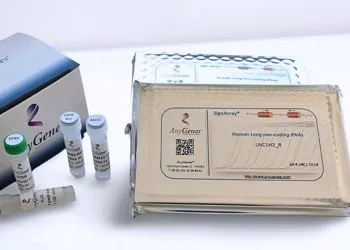
LncRNA qPCR assays, qPCR arrays, validated primers and custom panels.
SpeAmp® pre-amplification can support low-expression or limited-input workflows.
RNA-seq is a powerful discovery tool, but several limitations affect lncRNA analysis:
These limitations make validation of lncRNA RNA-seq essential to confirm expression changes.
RNA-seq results require validation due to variability and sensitivity limitations, particularly for low-expression transcripts, as demonstrated in benchmarking studies (Everaert et al., 2017).
Validating lncRNA candidates is more complex than validating many protein-coding genes. Long non-coding RNAs often show low abundance, multiple transcript isoforms and overlapping genomic regions.
Weak signals can make qPCR detection difficult, especially in limited or degraded samples.
Different transcript variants may affect primer design and interpretation of validation results.
Some lncRNAs overlap coding genes or regulatory regions, increasing the need for assay specificity.
LncRNA annotations may differ between databases, requiring transcript-aware assay selection.
FFPE, LCM, single-cell or low-input RNA samples may require adapted workflows.
Appropriate reference genes are essential for reliable comparison between qPCR and RNA-seq trends.
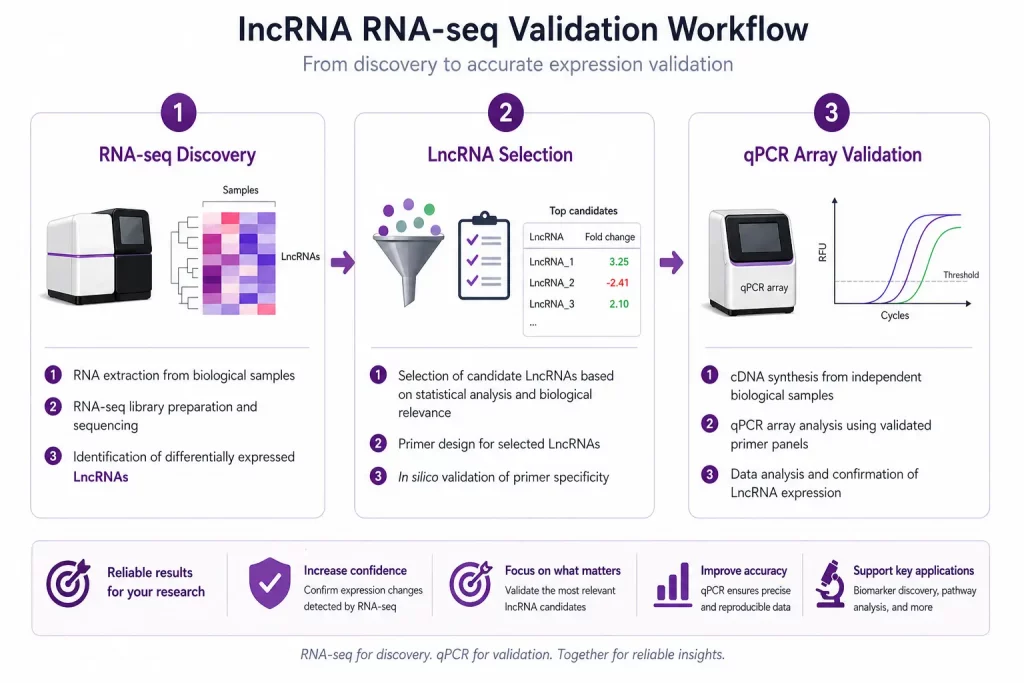
A robust validation workflow should connect candidate selection, transcript-aware assay design, sample quality control and qPCR data interpretation.
Prioritize candidates based on fold change, statistical significance and biological relevance.
Review isoforms, genomic overlap and potential specificity issues before primer selection.
Select validated lncRNA assays or design specific primers adapted to the selected targets.
Use consistent RNA quality control, reverse transcription and genomic DNA management.
Use technical and biological replicates with appropriate experimental controls.
Interpret qPCR results in relation to RNA-seq expression direction and biological context.
AnyGenes® supports lncRNA RNA-seq validation with targeted qPCR solutions designed for complex RNA targets and biomarker-oriented research.
Assays designed to support specific detection of selected long non-coding RNA targets.
96- and 384-well formats for multi-target validation and focused lncRNA screening.
Panels designed from selected RNA-seq candidate lists and research objectives.
Primer design adapted to transcript structure, specificity and qPCR reproducibility.
Pre-amplification support for low-expression or limited-input RNA samples.
Support for assay selection, experimental design and interpretation of qPCR validation results.
Some lncRNA candidates identified by RNA-seq are expressed at very low levels and may be difficult to validate directly by qPCR.
This is especially important when working with rare samples, FFPE material, LCM samples or limited RNA input.
SpeAmp® can support low-input workflows and help researchers validate selected lncRNA candidates when sample quantity or transcript abundance is limited.
Quantitative PCR is commonly used as a targeted method to validate selected RNA-seq findings because it supports sensitive and specific quantification of defined RNA targets.
For validation of lncRNA RNA-seq, qPCR helps confirm selected candidates and strengthen confidence in biologically relevant expression changes.
LncRNA RNA-seq validation by qPCR is useful when selected candidates need to be confirmed before biomarker prioritization, pathway interpretation or downstream functional studies.
Confirm lncRNA candidates associated with tumor biology, diagnostic signatures, prognostic markers or treatment-response studies.
Validate lncRNAs linked to immune regulation, cytokine signaling, inflammatory responses or disease-associated immune pathways.
Confirm lncRNA expression changes identified in cardiovascular disease models, patient cohorts or biomarker discovery studies.
Validate lncRNA candidates involved in neuronal function, neuroinflammation, neurodegeneration or brain disease models.
Connect lncRNA expression changes with signaling pathways, regulatory mechanisms or gene expression signatures.
Confirm selected RNA-seq findings in independent sample groups to strengthen confidence in biologically relevant candidates.
Several technical and experimental design issues can reduce the reliability of lncRNA RNA-seq validation. Identifying these risks early helps improve qPCR specificity, reproducibility and interpretation.
Primers should be carefully designed and validated, especially for lncRNAs with isoforms, genomic overlap or low expression levels.
Different lncRNA isoforms may affect assay design and result interpretation, particularly when RNA-seq and qPCR do not target the same transcript region.
Some lncRNAs overlap coding genes or regulatory regions, which can increase the risk of non-specific amplification if assay specificity is not checked.
Candidate selection should consider statistical significance, expression level, biological relevance and technical feasibility.
Inappropriate normalization can distort qPCR validation results. Reference genes should be suitable for the sample type and experimental context.
FFPE, LCM, single-cell or low-input RNA samples may require optimized reverse transcription, pre-amplification or adapted qPCR strategies.
RNA-seq is highly effective for discovery, but validation of lncRNA RNA-seq requires a sensitive and targeted approach.
For complex transcripts, validated qPCR assays are essential to ensure specificity and reproducibility.
LncRNA RNA-seq validation by qPCR helps confirm selected transcriptomic findings and improves confidence in biologically relevant candidates.
Targeted qPCR validation helps confirm selected long non-coding RNA candidates identified by RNA-seq.
Low read counts, transcript annotation complexity and sample variability can affect the interpretation of lncRNA RNA-seq results.
qPCR is commonly used to measure selected RNA targets and compare expression trends with RNA-seq data.
Validated lncRNA qPCR assays help reduce non-specific amplification and improve confidence in expression analysis.
Pre-amplification strategies such as SpeAmp® can support validation when RNA input is limited or transcript abundance is low.
Confirmed lncRNA candidates can be prioritized for downstream biomarker research, pathway analysis or functional studies.
AnyGenes® can help you select validated lncRNA qPCR assays, design custom qPCR panels and adapt the workflow to low-expression or limited-input RNA samples.
LncRNA RNA-seq validation helps confirm selected long non-coding RNA candidates identified by transcriptomic analysis and supports more reliable biological interpretation.
qPCR is commonly used as a targeted method to confirm selected RNA-seq expression trends because it can provide sensitive and reproducible quantification of specific RNA targets.
The main challenges include low expression levels, transcript isoforms, genomic overlap, annotation variability and limited RNA input.
Standard primers should only be used if they have been carefully designed and validated for the selected lncRNA target. Because lncRNAs may present isoform complexity, genomic overlap and low expression, validated assays are recommended to improve specificity and reproducibility.
Yes. AnyGenes® can support custom qPCR panel design based on selected lncRNA candidates, biological models, sample constraints and research objectives.