Hi, Continue visiting your profile
user

Login

Email

Password

Create account
Forget password
AnyGenes
  • email login

Antibacterial Response – Signaling Pathways and Biomarker Analysis

What is the antibacterial response?

The antibacterial response is a fundamental component of the innate immune system that enables the body to detect, respond to, and eliminate bacterial infections. This defense mechanism relies on coordinated cellular and molecular processes that recognize bacterial components and activate immune signaling pathways.

When bacteria invade tissues, immune cells such as macrophages, neutrophils, and epithelial cells detect bacterial molecules through pattern recognition receptors (PRRs), including Toll-like receptors (TLRs). This recognition triggers intracellular signaling cascades that activate transcription factors and induce the expression of genes involved in inflammation, immune defense, and antimicrobial activity.

The antibacterial response involves the production of cytokines, chemokines, and antimicrobial peptides, which coordinate immune cell recruitment and bacterial elimination. Understanding these signaling mechanisms is essential for studying host–pathogen interactions and inflammatory diseases.

Innovative Gene Expression Tools from AnyGenes

The molecular activity of antibacterial response pathways can be investigated through gene expression profiling of immune receptors, cytokines, and antimicrobial genes, allowing researchers to characterize immune activation and host defense mechanisms.

Antibacterial response signaling pathway biomarker list
View the genes included in our Antibacterial Response SignArrays® qPCR panels.

Dive into the intricate mechanisms behind the body's defense against bacterial invaders and explore the crucial signaling pathways involved in antibacterial responses.

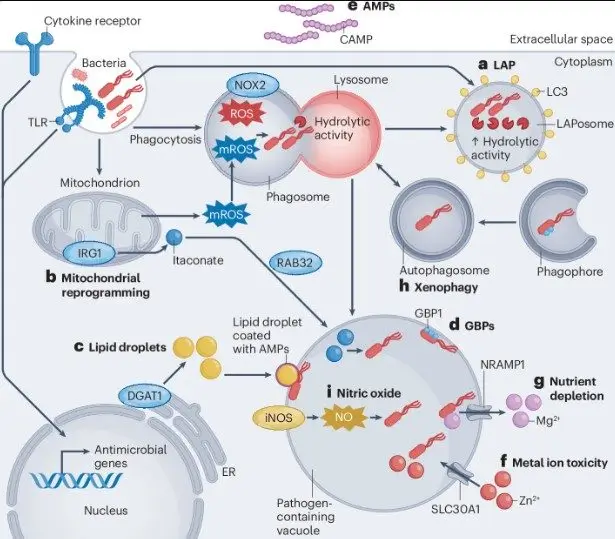
Overview of inducible antibacterial pathways in macrophages (graphic from Sweet MJ et al. 2024).

Key takeaways

  • The antibacterial response is part of the innate immune system
  • Toll-like receptors (TLRs) detect bacterial components
  • NF-κB and MAPK pathways regulate antibacterial gene expression
  • Cytokines and antimicrobial peptides coordinate bacterial elimination
  • Gene expression profiling enables analysis of antibacterial immune activation

Key molecules and receptors involved in antibacterial response

Several key molecules and receptors play pivotal roles in the response to bacteria.

Toll-like receptors (TLRs)

Toll-like receptors recognize bacterial components such as lipopolysaccharides (LPS), peptidoglycans, and bacterial DNA. Their activation initiates intracellular signaling pathways that regulate inflammatory and immune responses.

Cytokines and chemokines

Cytokines such as interleukins (IL-1, IL-6) and tumor necrosis factor (TNF), as well as chemokines, allow immune cells to communicate and coordinate the antibacterial response.

Immune cells

Neutrophils, macrophages, and T cells play essential roles in detecting and eliminating bacteria. These cells also produce cytokines and antimicrobial molecules that amplify the immune response

Signaling pathways activated during antibacterial response

Signaling pathways are activated when receptors such as Toll-like receptors detect bacterial components. This recognition triggers intracellular cascades involving signaling pathways such as NF-κB and MAPK.

These pathways activate transcription factors that translocate into the nucleus and induce the expression of genes involved in immune defense. This leads to the production of immune mediators, including cytokines, chemokines, and antimicrobial peptides that work together to eliminate bacterial threats.

The activation of these pathways is tightly regulated to ensure an effective immune response while preventing excessive inflammation

The role of antibacterial peptides

Antimicrobial peptides (AMPs) are key components of the innate immune system. These small peptides, produced by epithelial and immune cells, disrupt bacterial membranes and inhibit bacterial growth.

AMPs are rapidly produced at infection sites and provide a first line of defense against bacterial invasion. In addition to their direct antibacterial activity, antimicrobial peptides also modulate immune responses and inflammation.

Therapeutic applications and clinical relevance

Understanding antibacterial response signaling pathways is essential for developing new therapeutic strategies against bacterial infections.

Synthetic antimicrobial peptides with broad antibacterial properties are currently being investigated as therapeutic agents. Modulating antibacterial signaling pathways may also help treat conditions such as:

  • sepsis (excessive immune response)
  • chronic infections (insufficient immune response)
  • inflammatory diseases

Studying these pathways helps researchers identify new therapeutic targets and biomarkers of immune activation.

Why study antibacterial response with AnyGenes®

Understanding antibacterial immune mechanisms requires accurate and reproducible gene expression analysis.

AnyGenes® SignArrays® qPCR panels enable researchers to:

  • analyze antibacterial signaling pathway activation
  • quantify cytokines and immune response genes
  • study antimicrobial peptide expression
  • generate reproducible gene expression datasets

These pathway-focused qPCR arrays provide a robust platform for studying antibacterial immune responses in infection, inflammation, and translational research.

Biomarker analysis with AnyGenes®

The Antibacterial Response SignArrays® panel includes genes involved in:

  • pathogen recognition receptors
  • inflammatory cytokines
  • chemokines
  • antimicrobial peptides
  • immune signaling pathways

Available species: Homo sapiens, Mus musculus, Rattus norvegicus, Sus scrofa.

Custom panels can be developed to address specific research questions related to infection, inflammation, or host–pathogen interactions.

Analyze your pathway data with AnyGenes® software

Scientific data is only as powerful as the analysis behind it.

AnyGenes® provides a dedicated data analysis tool specifically developed for SignArrays® pathway panels.

What does it allow you to do?

  • Automated ΔCq calculation
  • Normalization with selected housekeeping genes
  • Comparison of up to 10 experimental conditions
  • Generation of descriptive statistics
  • Publication-ready graphs
  • Exportable tables for manuscripts and presentations

Developed on Excel (compatible with 2007+), the software is user-friendly and requires no advanced bioinformatics skills.

Customize your own signaling pathways (SignArrays®) with the factors of your choice!
Simply download and complete our Personalized SignArrays® information file and send it at [email protected] to initiate your project.

Frequently asked questions

What is antibacterial response?

The antibacterial response is part of the innate immune system that detects and eliminates bacterial infections through immune signaling pathways and antimicrobial molecules.

Which receptors detect bacteria?

Toll-like receptors (TLRs) and other pattern recognition receptors detect bacterial components and activate immune signaling pathways.

Which signaling pathways are involved in antibacterial response?

Major pathways include NF-κB, MAPK, and cytokine signaling pathways.

How can antibacterial response be studied experimentally?

It can be studied using gene expression profiling of immune response genes, cytokines, and antimicrobial peptides using qPCR arrays.

Which cells are involved in antibacterial defense?

Macrophages, neutrophils, epithelial cells, and T cells play key roles in antibacterial immune responses.

Antibacterial response biomarker list

You can check the biomarker list included in this pathway, see below:

Looking for more answers? Visit our Help & FAQ section to find detailed informations about our products, services, and technical support.

Scientific references

  1. Sweet MJ et al. Inducible antibacterial responses in macrophages. Nat Rev Immunol. (2024).
  2. Vijay K. Toll-like receptors in immunity and inflammatory diseases: Past, present, and future. Int Immunopharmacol. (2018); 59: 391–412.
  3. Duarte-Mata DI, Salinas-Carmona MC. Antimicrobial peptides’ immune modulation role in intracellular bacterial infection. Front Immunol. (2023); 14: 1119574.
  4. Li X et al. Antimicrobial mechanisms and clinical application prospects of antimicrobial peptides. Molecules. (2022); 27(9):2675.
Need pricing information or distributor details?
For quotations, product information, or project discussions, please contact our team at [email protected].