Hi, Continue visiting your profile
user

Login

Email

Password

Create account
Forget password
AnyGenes
  • email login

LncRNA qPCR vs RNA-seq: key differences and when to use each method

The comparison between lncRNA qPCR vs RNA-seq is a common topic in gene expression studies, especially when analyzing long non-coding RNAs.

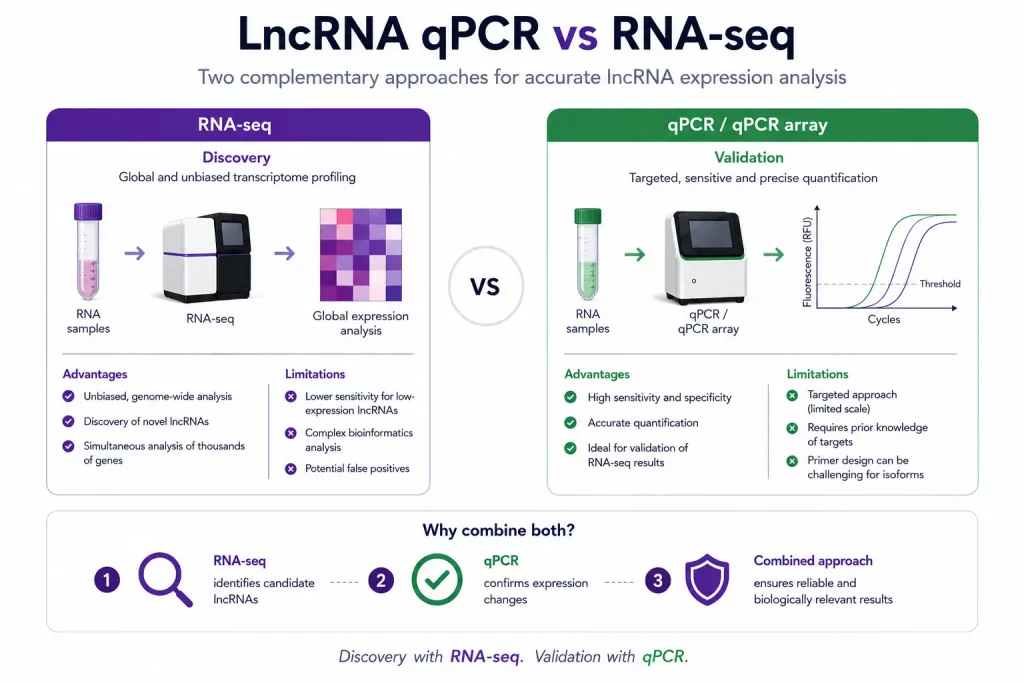
Although both methods are widely used, they serve different purposes. RNA sequencing (RNA-seq) enables large-scale transcript discovery, while qPCR and qPCR array approaches provide sensitive and targeted validation.

Understanding the differences between these technologies is essential to design reliable workflows and obtain biologically relevant results.

In addition to validated qPCR assays, AnyGenes provides gene expression analysis, RNA-seq validation, and biomarker discovery services based on proprietary high-throughput molecular platforms, supporting researchers worldwide.

Comparison workflow between RNA-seq discovery and qPCR array validation for lncRNA expression analysis.

What is RNA-seq and how is it used for lncRNA analysis

RNA sequencing (RNA-seq) is a high-throughput technology used for transcriptome-wide analysis.

It enables:

  • genome-wide transcriptome profiling
  • identification of novel lncRNAs
  • detection of differential gene expression

Advantages of RNA-seq

  • broad and unbiased analysis
  • discovery of unknown transcripts
  • simultaneous analysis of thousands of genes

Limitations of RNA-seq

  • lower sensitivity for low-expression lncRNAs
  • complex bioinformatics analysis
  • potential false positives

What is qPCR and why it is essential for lncRNA studies

Quantitative PCR (qPCR) is a targeted method used to measure gene expression with high sensitivity and specificity.

For lncRNA analysis, qPCR and qPCR array approaches provide:

  • sensitive detection of low-abundance transcripts
  • accurate quantification of expression changes
  • reliable validation of RNA-seq results

For very low-expression lncRNAs, preamplification strategies such as SpeAmp® can significantly improve detection sensitivity.

Comparison between RNA-seq and qPCR/qPCR array

Feature RNA-seq qPCR / qPCR array
Main purpose Discovery Validation
Sensitivity Moderate High
Throughput Very high Low to medium
Specificity Variable High
Quantification Relative Precise
Data analysis Complex Simpler
Best application Global transcriptome profiling Targeted validation

This comparison highlights why RNA-seq and qPCR should be considered complementary methods rather than competing technologies.

When to use RNA-seq for lncRNA analysis

RNA-seq is recommended when:

  • exploring unknown lncRNAs
  • performing transcriptome-wide studies
  • identifying new biomarkers
  • analyzing global expression patterns

It is typically the first step in gene expression discovery workflows.

When to use qPCR for lncRNA analysis

qPCR or qPCR array validation should be used when:

  • confirming RNA-seq results
  • quantifying specific lncRNAs
  • detecting low-abundance transcripts
  • validating biomarker candidates

qPCR remains essential for accurate and reproducible expression analysis.

Why lncRNA qPCR vs RNA-seq should be combined

  • Using both technologies together provides the most reliable workflow:
  • RNA-seq identifies candidate lncRNAs
  • qPCR confirms expression changes

This combined strategy helps:

  • reduce false positives
  • improve confidence in results

support reliable biomarker validation

Challenges in lncRNA analysis with RNA-seq and qPCR

Both methods present technical limitations.

RNA-seq challenges

  • sequencing bias
  • low sensitivity for weakly expressed transcripts
  • transcript annotation variability

qPCR challenges

  • primer specificity
  • isoform complexity
  • genomic overlap

These challenges require optimized experimental design and validated assays.

Reliable lncRNA analysis with AnyGenes

AnyGenes provides experimentally validated qPCR and qPCR array solutions designed for:

  • high specificity
  • detection of low-expression lncRNAs
  • reproducibility across experiments

These solutions complement RNA-seq workflows and improve data reliability for complex lncRNA studies.

Use cases of combined RNA-seq and qPCR approaches

  • cancer biomarker discovery and validation
  • immune pathway analysis
  • rare transcript detection
  • translational research
  • signaling pathway analysis

Common mistakes when comparing lncRNA qPCR vs RNA-seq

  • using RNA-seq data without validation
  • assuming equivalent sensitivity between methods
  • ignoring technical limitations
  • poor normalization strategies
  • insufficient experimental replicates

Expert insight

RNA-seq and qPCR should not be viewed as competing technologies.

Instead, they represent complementary approaches combining discovery and targeted validation to ensure accurate gene expression analysis.

For complex lncRNA studies, validated qPCR assays remain essential to confirm biologically relevant expression changes.

Key takeaways

  • RNA-seq is primarily used for transcript discovery
  • qPCR provides sensitive and precise validation
  • both methods are complementary
  • combined workflows improve reliability and reproducibility
  • validated assays are critical for accurate lncRNA analysis

Frequently asked questions about lncRNA qPCR vs RNA-seq

What is the difference between lncRNA qPCR vs RNA-seq?

RNA-seq is mainly used for transcript discovery, while qPCR is used for validation and precise quantification of gene expression changes.

Which method is more sensitive for lncRNA detection?

qPCR is generally more sensitive, especially for detecting low-expression lncRNA transcripts.

Is qPCR required after RNA-seq?

Yes. qPCR validation is strongly recommended to confirm RNA-seq results and reduce false positives.

Can RNA-seq replace qPCR?

No. RNA-seq and qPCR serve different purposes and should be used together for reliable gene expression analysis.

Scientific references

  1. Conesa A, Madrigal P, Tarazona S, et al. A survey of best practices for RNA-seq data analysis. Genome Biology. 2016;17:13. doi: 10.1186/s13059-016-0881-8.
  2. SEQC/MAQC-III Consortium. A comprehensive assessment of RNA-seq accuracy, reproducibility and information content by the Sequencing Quality Control Consortium. Genome Biology. 2014 Sep;32(9):903-14. doi: 10.1038/nbt.2957.
  3. Bustin SA, Benes V, Garson JA, et al. The MIQE guidelines: minimum information for publication of quantitative real-time PCR experiments. Clinical Chemistry. 2009;55(4):611–622. doi: 10.1373/clinchem.2008.112797.
  4. Vieira A, et al.Comparative Validation of Conventional and RNA-Seq Data Using qPCR in Colletotrichum kahawae. PLOS ONE. 2016 Mar 7;11(3):e0150651. doi: 10.1371/journal.pone.0150651.

Need support for your lncRNA project?

Whether you are comparing analytical methods or validating RNA-seq results, AnyGenes provides validated solutions and expert support tailored to your research needs.

Contact our experts to optimize your lncRNA qPCR and RNA-seq workflow.