Hi, Continue visiting your profile
user

Login

Email

Password

Create account
Forget password
AnyGenes
  • email login

Understanding the link between inflammation and autoimmunity

Inflammation and Autoimmunity are critical to immune response. Inflammation is a vital biological response that protects the body from harmful stimuli, such as pathogens, damaged cells, and irritants. However, in autoimmune diseases, this protective mechanism can become dysregulated, leading to the immune system mistakenly attacking the body’s own tissues. Conditions such as rheumatoid arthritis, lupus, and multiple sclerosis showcase how dysregulated inflammation impacts health.

AnyGenes provides innovative qPCR arrays that support high-throughput analysis of inflammatory and autoimmune markers, offering insights into immune responses and facilitating advancements in autoimmune research. Our customizable arrays enable researchers to explore gene expressions linked to inflammation and autoimmunity across various cell types, enhancing the study of disease mechanisms and potential therapeutic targets.

AnyGenes array for analyzing inflammation and autoimmunity biomarkers.

Discover our advanced qPCR arrays for inflammatory and autoimmune research.

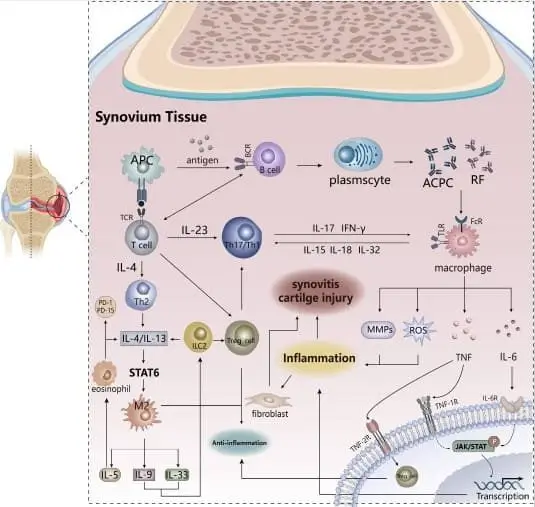
Inflammation ana autoimmunity in the pathogenesis of rheumatoid arthritis
The pathogenesis of RA. Antigen-presenting cells activate T cells and B cells to trigger adaptive immunity. B cells produce autoantibodies that stimulate macrophages to secrete pro-inflammatory factors and promote transcription of inflammatory genes. T cell differentiation into TH17 cells plays a pro-inflammatory role, and IL-4/IL-13 produced by TH2 cells triggers the activation of anti-inflammatory signaling pathways, and the production of anti-inflammatory factors and anti-inflammatory lipids is conducive to disease reversal. PD1 PD15, anti-inflammatory lipids. APCs, antigen-presenting cells. TCR, T cell receptor. TLR, Toll-like receptor.

Autoimmunity: breakdown of immune tolerance

Autoimmunity arises when the immune system fails to distinguish between self and non-self, leading to the destruction of healthy tissues. Immune cells, including T cells and B cells, become hyperactive, attacking healthy tissues. This leads to a cycle of chronic inflammation and tissue damage. Researchers are increasingly focusing on how immune tolerance is broken and how signaling pathways can be targeted to restore this balance. Understanding the molecular mechanisms behind immune tolerance and signaling pathways is essential for developing therapeutic strategies.

The link between inflammation and autoimmunity

The relationship between inflammation and autoimmunity is intricate. Chronic inflammation can exacerbate autoimmune responses by promoting the activation of immune cells, such as macrophages and T cells, that target self-tissues. For instance, in conditions like rheumatoid arthritis, inflammatory cytokines such as TNF-α and IL-1β play significant roles in perpetuating the disease process by sustaining inflammation and driving autoimmunity.

Inflammation and autoimmunity: mechanism of action

  • Cytokine Release: Inflammatory cytokines can enhance the activation of autoreactive T cells and B cells, leading to increased production of autoantibodies.
  • Inflammasome Activation: The NLRP3 inflammasome, for example, has been implicated in various autoimmune diseases by promoting inflammatory responses that damage tissues.
  • Loss of Immune Tolerance: Chronic exposure to inflammatory stimuli can disrupt the mechanisms that normally prevent the immune system from attacking self-antigens.

Current treatment approaches

Management of autoimmune diseases often focuses on reducing inflammation and modulating the immune response.

  • Anti-inflammatory Medications: Non-steroidal anti-inflammatory drugs (NSAIDs) and corticosteroids are commonly used, but may have side effects.
  • Biologics: Newer therapies target specific components of the immune system (e.g., TNF inhibitors) to reduce inflammation more effectively.
  • Lifestyle Modifications: Diet, exercise, and stress management can also play crucial roles in managing symptoms.

Analyze your pathway data with AnyGenes® software

Scientific data is only as powerful as the analysis behind it.

AnyGenes® provides a dedicated data analysis tool specifically developed for SignArrays® pathway panels.

What does it allow you to do?

  • Automated ΔCq calculation
  • Normalization with selected housekeeping genes
  • Comparison of up to 10 experimental conditions
  • Generation of descriptive statistics
  • Publication-ready graphs
  • Exportable tables for manuscripts and presentations

Developed on Excel (compatible with 2007+), the software is user-friendly and requires no advanced bioinformatics skills.

Customize your own signaling pathways (SignArrays®) with the factors of your choice!
Simply download and complete our Personalized SignArrays® information file and send it at [email protected] to initiate your project.

Inflammation & autoimmunity biomarker list

You can check the biomarker list included in this pathway, see below:

Looking for more answers? Visit our Help & FAQ section to find detailed informations about our products, services, and technical support.

Bibliography

1. Xiang Y, et al. The role of inflammation in autoimmune disease: a therapeutic target. Front Immunol. (2023)4:14:1267091.

2. Padoan A, et al. Inflammation, Autoinflammation and Autoimmunity in Inflammatory Bowel Diseases. Curr Issues Mol Biol. (2023)30;45(7):5534–5557.

3. Misra R, et al. Editorial: Autoimmunity and Chronic Inflammation in Early Life. Front Immunol. (2021)9;12:761160.

4. Duan L, et al. Regulation of Inflammation in Autoimmune Disease. J Immunol Res. (2019)28;2019:7403796.

Need pricing information or distributor details?
For quotations, product information, or project discussions, please contact our team at [email protected].