
Hi, Continue visiting your profile
user

Login

Email

Password

Create account
Forget password
AnyGenes
  • email login

DNA methylation analysis services for epigenetic research

AnyGenes® provides DNA methylation analysis services for targeted and broader epigenetic research, with approaches including methylation-specific quantitative PCR, MS-HRM, pyrosequencing, global methylation assessment and bisulfite sequencing.

The analytical strategy can be adapted to the biological question, genomic region, starting material and level of methylation information required, from selected CpG sites to broader methylation profiling.
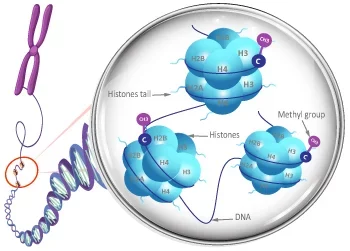
Targeted CpG analysis Bisulfite-based approaches 5mC & 5hmC investigation
DNA methylation analysis for epigenetic research at AnyGenes®

Explore complementary biomarker research services

DNA methylation analysis can complement targeted biomarker validation, cell-based experimental studies and molecular data analysis depending on the biological question, available material and stage of the research project.

DNA methylation as a layer of epigenetic regulation

DNA methylation is an epigenetic modification involved in the regulation of genome function without changing the underlying DNA sequence. In mammalian genomes, 5-methylcytosine (5mC) frequently occurs at cytosines within CpG dinucleotides.

5-methylcytosine and CpG sites

DNA methyltransferases can add a methyl group to cytosine, generating 5-methylcytosine. The biological relationship between CpG methylation and transcription depends on the genomic context, including the regulatory region being investigated.

5-hydroxymethylcytosine

5-hydroxymethylcytosine (5hmC) is a related but distinct cytosine modification generated through oxidation of 5mC. Distinguishing 5mC from 5hmC can therefore be important for specific epigenetic research questions.

Biological and experimental context

DNA methylation patterns can vary with cell type, development, differentiation, disease state and environmental or experimental conditions. Their interpretation should therefore consider both genomic location and biological context.

How bisulfite conversion supports DNA methylation analysis

Many DNA methylation methods rely on bisulfite conversion to create a sequence difference between unmethylated and methylated cytosines. This difference can subsequently be detected by PCR or sequencing to investigate and quantify methylation within selected genomic regions.
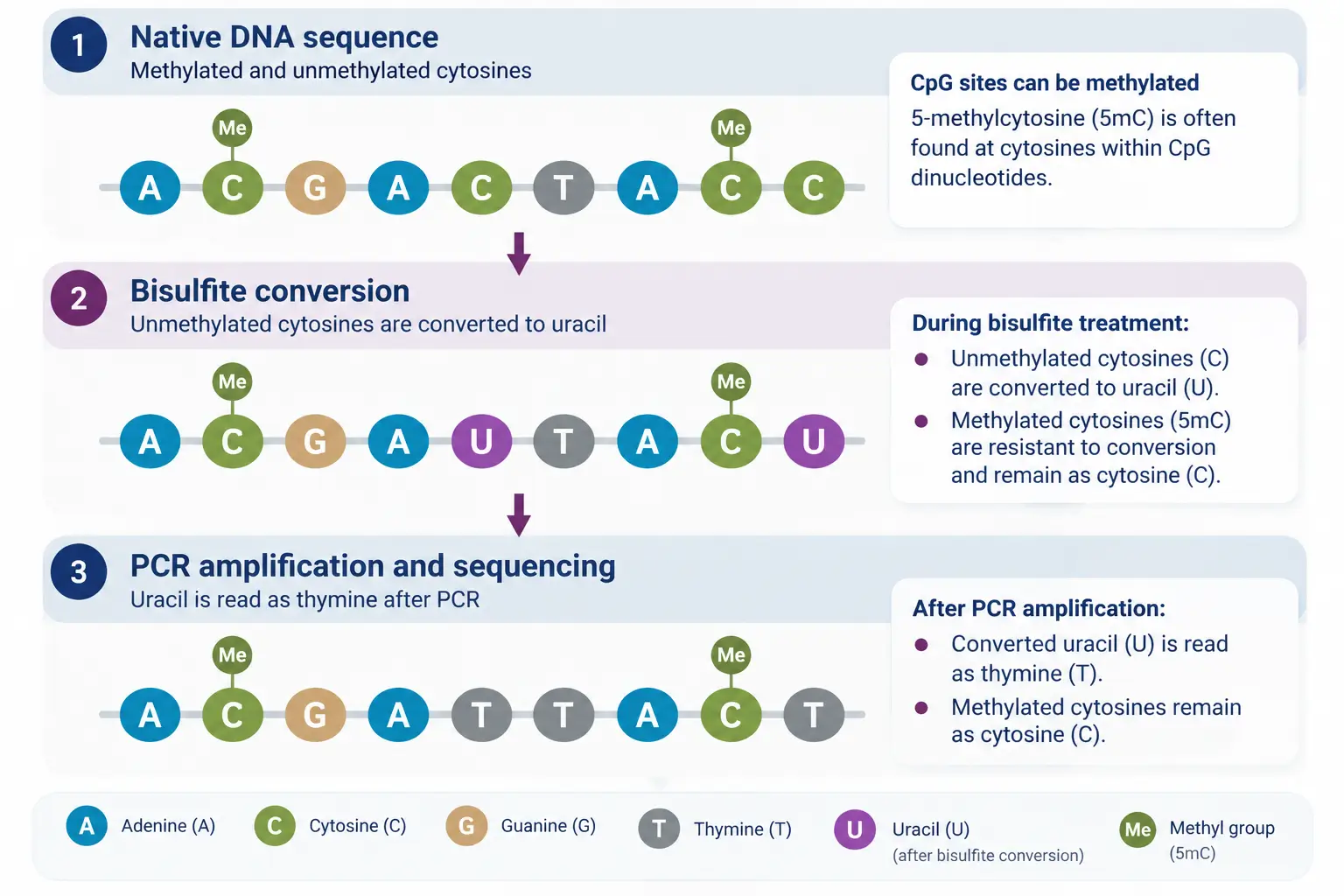
Principle of bisulfite conversion and PCR-based DNA methylation analysis

Principle of bisulfite-based methylation analysis

During standard bisulfite treatment, unmethylated cytosines are converted to uracil, whereas 5-methylcytosine (5mC) is protected from conversion.

After PCR amplification, converted positions are read as thymine, while methylated cytosines remain detectable as cytosine. This sequence difference provides the basis for several targeted PCR- and sequencing-based methods used to detect and quantify DNA methylation.

Important distinction between 5mC and 5hmC: standard bisulfite-based methods do not distinguish 5-methylcytosine from 5-hydroxymethylcytosine. AnyGenes® has developed a dedicated protocol for projects requiring specific quantification of 5hmC.

DNA methylation analysis methods for different research questions

The appropriate method depends on whether the project requires targeted analysis of selected CpG regions, quantitative methylation assessment, broader methylation profiling or sequencing of bisulfite-converted DNA.

Founded in 2007, AnyGenes® provides epigenetic and DNA methylation analysis services using complementary PCR- and sequencing-based approaches.

Methylation analysis by MSqP

Methylation-specific quantitative PCR (MSqP) can be used to detect and quantify methylation within selected genomic regions after bisulfite conversion using methylation-specific primers and probes.

Explore MSqP methylation analysis

Methylation analysis by MS-HRM

Methylation-sensitive high-resolution melting analysis uses melting-profile differences in bisulfite-converted DNA to investigate methylation within selected genomic regions.

Explore MS-HRM analysis

Global DNA methylation analysis

LINE-1-based methylation assessment can be used as a surrogate approach for investigating broader changes in genomic DNA methylation across experimental conditions.

Explore global methylation analysis

Pyrosequencing methylation analysis

Pyrosequencing of bisulfite-converted DNA enables quantitative investigation of methylation at selected CpG positions within targeted genomic regions.

Explore pyrosequencing

Reduced representation bisulfite sequencing (RRBS)

RRBS can provide broader CpG-focused methylation profiling by enriching CpG-rich portions of the genome before bisulfite sequencing and bioinformatic analysis.

Targeted bisulfite sequencing

Targeted bisulfite sequencing can investigate methylation across selected genomic regions when sequencing-level resolution is required for a predefined set of targets.

Starting material and project requirements for DNA methylation analysis

The appropriate workflow depends on the biological material, DNA characteristics, genomic targets and methylation information required for the study.

Biological material

Depending on the method and project, methylation studies can start from biological samples such as tissues, biopsies, blood or FFPE material, subject to sample suitability and DNA quality.

Extracted genomic DNA

Projects can also begin from extracted genomic DNA when material has already been prepared and is compatible with the selected methylation analysis workflow.

Genes and genomic regions

For targeted approaches, information about the gene, genomic region or CpG sites of interest helps define assay design and select the most appropriate analytical method.

Research applications of DNA methylation analysis

DNA methylation studies can support the investigation of epigenetic changes across different biological and experimental contexts. Interpretation depends on the genomic region, cell or tissue type, study design and research question.

Gene regulation

Investigate methylation patterns within selected regulatory or genomic regions in relation to gene regulation and molecular phenotype.

Development and differentiation

Examine methylation changes associated with developmental processes, cellular differentiation or changes in cell state.

Disease-related epigenetic research

Compare methylation patterns between defined experimental or biological groups to investigate epigenetic changes associated with disease-related processes.

Environmental and experimental responses

Study methylation differences associated with environmental exposures, treatment conditions or other experimentally defined biological contexts.

Connect DNA methylation analysis with targeted epigenetic gene-expression profiling

DNA methylation provides one layer of epigenetic information. Depending on the research question, methylation analysis can be complemented by targeted gene-expression profiling of enzymes and regulators involved in epigenetic processes.

DNA methylation analysis

Investigate methylation at selected CpG regions or across broader sets of genomic sites using an analytical method adapted to the required resolution.

Epigenetic Regulation SignArrays®

Explore targeted expression of genes involved in DNA methylation, histone modification, chromatin regulation and related epigenetic processes using pathway-focused qPCR arrays.

Explore Epigenetic Regulation SignArrays®

Frequently asked questions about DNA methylation analysis

Common questions about bisulfite conversion, methylation methods, 5mC and 5hmC, starting material and targeted epigenetic analysis.

What is DNA methylation analysis?

DNA methylation analysis investigates the methylation status of cytosines within defined genomic regions or across broader sets of CpG sites. Different methods can provide targeted, relative, quantitative or sequencing-based information depending on the research question.

How does bisulfite conversion enable DNA methylation analysis?

Standard bisulfite treatment converts unmethylated cytosines to uracil while 5-methylcytosine remains protected from conversion. After PCR amplification or sequencing, this difference can be used to investigate methylation at selected genomic positions.

Can standard bisulfite analysis distinguish 5mC from 5hmC?

No. Standard bisulfite-based methods do not distinguish 5-methylcytosine from 5-hydroxymethylcytosine. A dedicated analytical approach is required when specific quantification or investigation of 5hmC is needed.

Which DNA methylation analysis methods does AnyGenes® provide?

AnyGenes® provides complementary approaches including MSqP, methylation-sensitive high-resolution melting analysis, global methylation assessment, pyrosequencing, reduced representation bisulfite sequencing and targeted bisulfite sequencing. The appropriate method depends on the genomic targets and level of resolution required.

What types of samples can be used for DNA methylation analysis?

Depending on the analytical method and sample quality, projects may begin from tissues, biopsies, blood, FFPE material or extracted genomic DNA. Sample suitability should be reviewed before the methylation workflow is defined.

Can DNA methylation analysis be combined with gene-expression analysis?

Yes. Depending on the biological question, DNA methylation analysis can be complemented by targeted gene-expression profiling, including qPCR analysis of genes involved in epigenetic regulation. These approaches provide different but complementary molecular information.

Need a DNA methylation strategy for your research project?

Tell us about your biological material, genomic targets, research question and the level of methylation information required. Our scientific team can discuss an approach adapted to your samples and determine which methylation analysis method best fits the project.