Hi, Continue visiting your profile
user

Login

Email

Password

Create account
Forget password
AnyGenes
  • email login

TNF Signaling Pathway – Inflammation, Cell Fate and Biomarker Analysis

What is the TNF signaling pathway?

The  TNF signaling pathway, (Tumor Necrosis Factor pathway) is a central regulator of inflammation, immune responses, and cell fate decisions. Activated in response to infection, tissue injury, or immune stress, this pathway controls a balance between cell survival, inflammatory gene expression, and programmed cell death.

Tumor Necrosis Factor (TNF-α) exerts its biological effects through two main receptors, TNFR1 and TNFR2, which activate distinct but interconnected signaling cascades. Depending on the cellular context, TNF signaling can promote inflammation and tissue repair, or trigger apoptosis and inflammatory cell death.

TNF Signaling Pathway with AnyGenes qPCR array biomarker analysis.

Dysregulated TNF signaling is a hallmark of chronic inflammatory diseases, autoimmune disorders, and cancer, making this pathway a major focus of biomedical research and therapeutic development.

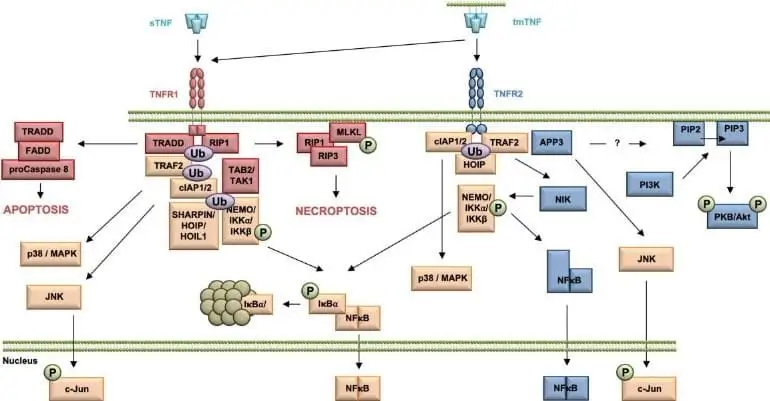
Overview of the TNFR1 and TNFR2 signaling pathway.
Overview of the TNFR1 and TNFR2 signaling pathway. All TNFR1-exclusive signaling mediators are marked red, whereas all TNFR2-exclusive signaling components are shown in blue. All mediators used by both pathways are labeled orange.

Key takeaways

  • Master regulator of inflammation and immune responses
  • Controls NF-κB, MAPK, and apoptosis signaling
  • Central role in autoimmune and inflammatory diseases
  • Strong therapeutic relevance (anti-TNF therapies)
  • Highly suitable for biomarker discovery and gene expression profiling

Core components of the TNF signaling pathway

TNF and TNF receptors (TNFR1 / TNFR2)

TNF-α initiates signaling by binding to TNFR1 or TNFR2. TNFR1 is ubiquitously expressed and mediates most pro-inflammatory and apoptotic effects, while TNFR2 is more restricted and associated with immune regulation and tissue repair.

Adaptor proteins (TRADD, TRAF2, RIPK1)

Upon receptor engagement, adaptor proteins such as TRADD, TRAF2, and RIPK1 assemble signaling complexes that determine downstream pathway activation.

NF-κB signaling

TNF signaling strongly activates the NF-κB pathway, leading to transcription of pro-inflammatory cytokines, chemokines, and survival genes.

MAPK signaling

The TNF pathway activates MAPK cascades (ERK, JNK, p38), regulating stress responses, proliferation, differentiation, and inflammatory gene expression.

Caspase activation and apoptosis

Under specific conditions, TNF signaling recruits FADD and caspase-8, triggering apoptosis and contributing to immune regulation and tissue homeostasis.

Mechanisms of TNF signaling

TNF signaling operates through multiple interconnected branches:

  • Pro-survival and inflammatory signaling via NF-κB and MAPKs
  • Apoptotic signaling via caspase-8 activation
  • Inflammatory cell death depending on cellular context and regulatory balance

Secondary messengers such as reactive oxygen species (ROS) and calcium ions further modulate TNF-dependent responses. Tight feedback mechanisms, including soluble TNF receptors and inhibitory proteins, prevent excessive pathway activation.

Biological functions of the TNF pathway

TNF signaling regulates:

  • Acute and chronic inflammation
  • Innate and adaptive immune responses
  • Cell survival, proliferation, and differentiation
  • Apoptosis and inflammatory cell death
  • Tissue repair and immune homeostasis

TNF signaling pathway in disease

Inflammatory and autoimmune diseases

Chronic TNF activation is a key driver of:

  • Rheumatoid arthritis
  • Inflammatory bowel disease
  • Psoriasis
  • Ankylosing spondylitis

Cancer

TNF signaling can promote tumor progression by sustaining inflammation, supporting angiogenesis, and shaping the tumor microenvironment, while also contributing to immune surveillance in certain contexts.

Metabolic and degenerative disorders

Aberrant TNF signaling is implicated in insulin resistance, cardiovascular diseases, and neurodegenerative conditions.

Therapeutic targeting of the TNF pathway

The TNF pathway is one of the most successfully targeted signaling pathways in medicine:

  • Anti-TNF biologics (e.g. infliximab, adalimumab) are widely used in autoimmune diseases
  • Selective targeting of TNFR1 versus TNFR2 is an emerging strategy to rebalance inflammation and tissue repair
  • Combination approaches aim to reduce inflammation while preserving protective immune functions

Accurate biomarker profiling of TNF signaling is essential for patient stratification and treatment monitoring.

Why study the TNF signaling pathway with AnyGenes?

At AnyGenes®, we provide high-performance qPCR arrays and customizable SignArrays® dedicated to TNF pathway analysis.

Our solutions enable researchers to:

  • Quantify TNF-dependent gene expression signatures
  • Analyze NF-κB, MAPK, and apoptosis-related targets
  • Investigate inflammatory and immune biomarker panels
  • Generate robust, reproducible, publication-ready data

TNF signaling pathway biomarker analysis with AnyGenes®

What can be analyzed?

  • TNF and TNF receptors (TNFR1, TNFR2)
  • Adaptor proteins and kinases (TRADD, RIPK1, MAPKs)
  • NF-κB-regulated inflammatory genes
  • Apoptosis- and cell death-related markers

Customize your own signaling pathways (SignArrays®) with the factors of your choice!
Simply download and complete our Personalized SignArrays® information file and send it at [email protected] to initiate your project.

Frequently asked questions

It is a cytokine-driven signaling pathway that regulates inflammation, immune responses, cell survival, and apoptosis through TNF receptor activation.

TNFR1 mainly mediates pro-inflammatory and apoptotic signaling, while TNFR2 is associated with immune regulation and tissue repair.

Persistent TNF activation sustains chronic inflammation, making TNF a key therapeutic target in autoimmune disorders.

By measuring expression of pathway regulators and downstream targets using targeted gene expression approaches such as qPCR pathway arrays.

  1. Fischer R, et al. Selective Targeting of TNF Receptors as a Novel Therapeutic Approach. Front Cell Dev Biol. (2020)26;8:401.
  2. Webster JD, Vucic D. The Balance of TNF Mediated Pathways Regulates Inflammatory Cell Death Signaling in Healthy and Diseased Tissues. Front Cell Dev Biol. (2020)21:8:365.
  3. Holbrook J, et al. Tumour necrosis factor signalling in health and disease. F1000Res. (2019)28;8:F1000 Faculty Rev-111.

TNF signaling pathway biomarker list

You can check the biomarker list included in this pathway, see below:

Looking for more answers? Visit our Help & FAQ section to find detailed informations about our products, services, and technical support.

For more information on prices, please contact us at: