Autophagy Pathway – Cellular Recycling, Stress Adaptation and Biomarker Analysis
What is the autophagy pathway?
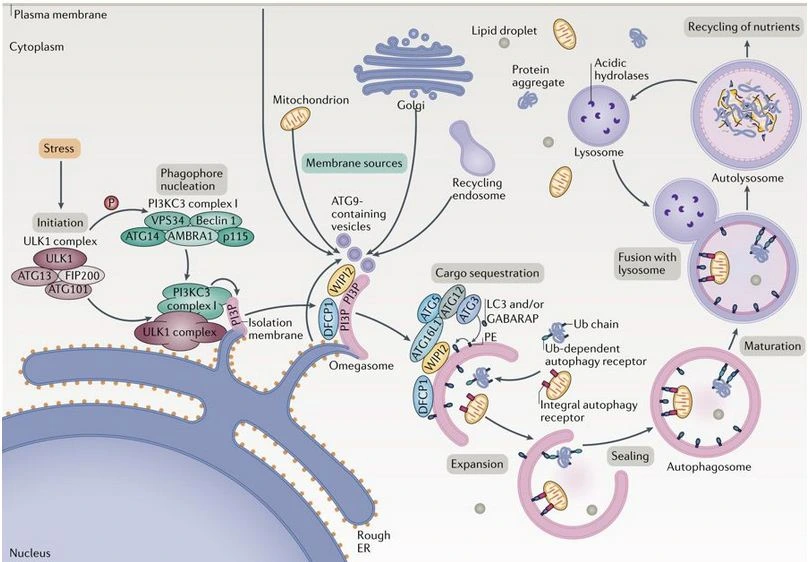
The autophagy pathway is a highly regulated cellular degradation and recycling system that maintains cellular homeostasis under stress conditions such as nutrient deprivation, oxidative stress, hypoxia, and protein aggregation.
Autophagy enables cells to degrade damaged organelles, misfolded proteins, and cytoplasmic components through lysosomal degradation, thereby promoting survival, metabolic adaptation, and longevity.
Dysregulation of autophagy is strongly associated with cancer, neurodegenerative disorders, metabolic diseases, infectious diseases, and aging-related pathologies.
Autophagy pathway activity can be efficiently assessed by measuring gene expression of ATG regulators, lysosomal markers, and pathway-specific biomarker signatures.
Autophagy pathway biomarker analysis with AnyGenes®
What can be analyzed?
ATG family genes
ULK1/ULK2 complex components
LC3 (MAP1LC3B) and lysosomal markers (LAMP1)
SQSTM1 (p62) and selective autophagy adaptors
mTOR and AMPK pathway regulators
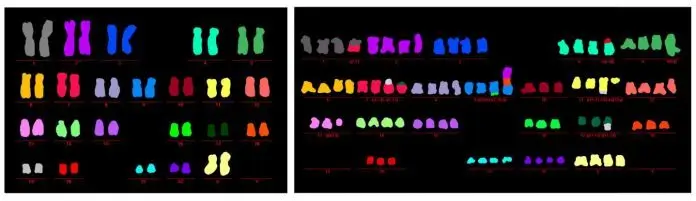
Autophagic cell death restricts chromosomal instability during replicative crisis
Left: The 23 pairs of chromosomes of cells in which autophagy is functioning look normal and healthy with no structural or numerical aberrations (each color represents a unique chromosome pair).
Right: the chromosomes of cells in which autophagy is not functioning bypass crisis, showing both structural and numerical aberrations, with segments added to, deleted from, and/or swapped between chromosomes – a hallmark of cancer. [Salk Institute]
Analyze your pathway data with AnyGenes® software
Scientific data is only as powerful as the analysis behind it.
AnyGenes® provides a dedicated data analysis tool specifically developed for SignArrays® pathway panels.
What does it allow you to do?
Automated ΔCq calculation
Normalization with selected housekeeping genes
Comparison of up to 10 experimental conditions
Generation of descriptive statistics
Publication-ready graphs
Exportable tables for manuscripts and presentations
Developed on Excel (compatible with 2007+), the software is user-friendly and requires no advanced bioinformatics skills.
The autophagy pathway is a cellular degradation and recycling system that removes damaged organelles and proteins through lysosomal degradation to maintain cellular homeostasis
How is autophagy regulated?
Autophagy is regulated primarily by mTOR (inhibitory) and AMPK (activating), which control the ULK complex responsible for autophagy initiation.
What genes are involved in the autophagy pathway?
Key genes include ATG5, ATG7, ATG12, BECN1, MAP1LC3B (LC3), SQSTM1 (p62), ULK1 and LAMP1.
What is the role of autophagy in cancer?
Autophagy can suppress tumor initiation but later support tumor survival, metabolic adaptation, and resistance to therapy.
How can autophagy pathway activity be analyzed?
Autophagy activity can be assessed by measuring expression of ATG genes, lysosomal markers, and pathway regulators using targeted gene expression tools such as qPCR pathway arrays.
Autophagy signaling pathway biomarker list
You can check the biomarker list included in this pathway, see below:
Looking for more answers? Visit our Help & FAQ section to find detailed informations about our products, services, and technical support.
Bibliography
1. Mizushima N. & Komatsu M. Autophagy: renovation of cells and tissues. Cell (2011) 147(4):728-741.
2. Klionsky, D. J. et al. A comprehensive glossary of autophagy- related molecules and processes (2nd edition). Autophagy (2011) 7(11):1273-1294.
3. Debnath J, et al. Autophagy and autophagy-related pathways in cancer. Nat Rev Mol Cell Biol. (2023);24(8):560-575.
4. Dikic I. & Elazar Z. Mechanism and medical implications of mammalian autophagy. Nat Rev Mol Cell Biol. (2018) 19(6):349-364.
5. Ma Y. et al. Autophagy and cellular immune responses. Immunity (2013) 39(2): 211-227.
6. Kimmelman A. C. & White E. Autophagy and tumor metabolism. Cell Metab. (2017) 25(5): 1037-1043.
7. Nassour J & al. Autophagic cell death restricts chromosomal instability during replicative crisis. Nature. (2019).
8. Klionsky DJ, et al. Autophagy in major human diseases. EMBO J. (2021);40(19):e108863.
9. Yamamoto H, et al. Autophagy genes in biology and disease. Nat Rev Genet. (2023);24(6):382-400.
Need pricing information or distributor details?
For quotations, product information, or project discussions, please contact our team at
[email protected].