Antiviral Response Signaling Pathway – Mechanism and Biomarker Analysis
What is the antiviral response signaling pathway?
The antiviral response signaling pathway is a highly coordinated network of innate and adaptive immune mechanisms that detect viral infections and orchestrate cellular defense programs to limit viral replication and spread.
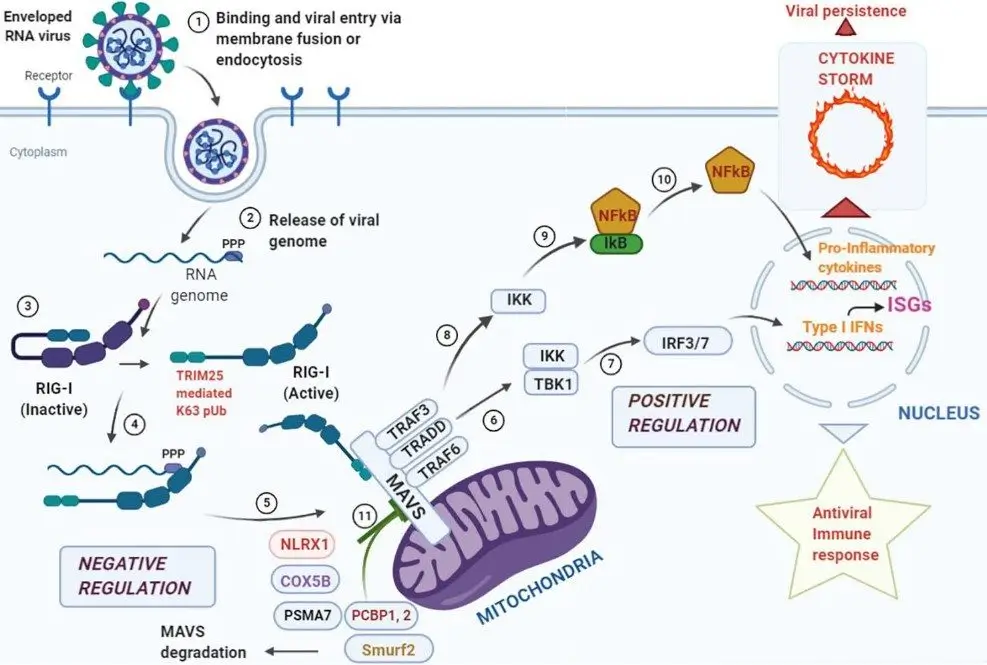
At the molecular level, antiviral signaling is initiated by pattern recognition receptors (PRRs) such as Toll-like receptors (TLRs), RIG-I-like receptors (RLRs), and cytosolic DNA sensors. These receptors detect viral nucleic acids and activate downstream signaling cascades involving key adaptors such as MAVS, TRIF, and MyD88. This leads to the activation of transcription factors including NF-κB, IRF3, and IRF7, which drive the expression of interferons (IFNs) and antiviral genes.
Biologically, the antiviral response is essential for maintaining host integrity. It coordinates the activation of natural killer (NK) cells, cytotoxic T lymphocytes, macrophages, and B cells, ensuring both rapid innate defense and long-term adaptive immunity. Dysregulation of this pathway can result in chronic viral persistence, excessive inflammation, or immune-mediated tissue damage.
Antiviral pathway activity can be efficiently assessed by measuring transcriptional changes in interferon-stimulated genes (ISGs), PRRs, and cytokine signaling components. Such gene expression profiling enables discrimination between early innate activation and sustained adaptive immune responses.
Molecular mechanism of the antiviral response pathway
Viral recognition and PRR activation
Viral infection is first detected through PRRs that recognize pathogen-associated molecular patterns (PAMPs), including viral RNA and DNA. Endosomal TLRs and cytosolic sensors such as RIG-I and cGAS initiate signaling upon ligand binding
MAVS signalosome and downstream signaling
Following detection, RLR activation leads to the recruitment of MAVS at the mitochondrial membrane, forming the MAVS signalosome. This complex activates kinases such as TBK1 and IKKε, which phosphorylate IRF3 and IRF7
Transcriptional activation of antiviral genes
Activated IRFs and NF-κB translocate into the nucleus, inducing the expression of type I interferons and pro-inflammatory cytokines.
Interferon amplification loop
Secreted interferons bind to their receptors and activate the JAK-STAT pathway, leading to the induction of interferon-stimulated genes (ISGs), which establish an antiviral state within infected and neighboring cells.
Gene expression profiling provides a robust approach to monitor antiviral pathway activation and immune status.
The panel integrates antiviral sensing, interferon signaling, inflammasome activation, and stress-response pathways, providing a comprehensive transcriptional view of antiviral immunity across innate and adaptive responses.
Example biomarkers
IFNB1, ISG15, MX1, OAS2, CXCL10, DDX58, NLRP3…
Biological functions of the antiviral response pathway
Viral detection and immune activation
Inhibition of viral replication
Activation of cytotoxic immune cells
Regulation of inflammatory responses
Establishment of immune memory
Therapeutic Relevance
Antiviral agents targeting viral replication
Interferon-based therapies
Immunomodulatory approaches
Vaccine-induced immune activation
T-cell-based therapies
Disease Relevance
Cancer
Chronic viral infections (e.g., HPV, HBV) contribute to oncogenesis and affect immune surveillance.
Inflammatory diseases
Persistent interferon signaling is associated with autoimmune conditions such as lupus.
Metabolic disorders
Chronic inflammation linked to viral infections may contribute to metabolic dysregulation.
Neurological diseases
Neurotropic viral infections and immune responses can drive neuroinflammation and neurodegeneration.
Why Study Antiviral Response with AnyGenes®
AnyGenes® develops and customizes SignArrays® qPCR panels for antiviral pathway analysis, enabling:
Comprehensive pathway profiling
Accurate quantification of antiviral biomarkers
High reproducibility across experiments
Standardized data generation for publication
Biomarker Analysis with AnyGenes®
Our antiviral response panels include:
Curated gene sets covering PRRs, interferon signaling, and interferon-stimulated genes (ISGs), which represent a transcriptional signature of pathway activation
Multi-species availability (human, mouse, rat, pig)
Custom panel design tailored to specific research needs
Analyze your pathway data with AnyGenes® software
Scientific data is only as powerful as the analysis behind it.
AnyGenes® provides a dedicated data analysis tool specifically developed for SignArrays® pathway panels.
What does it allow you to do?
Automated ΔCq calculation
Normalization with selected housekeeping genes
Comparison of up to 10 experimental conditions
Generation of descriptive statistics
Publication-ready graphs
Exportable tables for manuscripts and presentations
Developed on Excel (compatible with 2007+), the software is user-friendly and requires no advanced bioinformatics skills.
6. Ellebedy AH, Ahmed R. Antiviral Vaccines: Challenges and Advances. The Vaccine Book. (2016) : 283–310.
7. Fumagalli v, Iannacone M. The interplay of drug therapeutics and immune responses to SARS-CoV-2. Cell Mol Immunol. (2024);21(2):197-200.
Need pricing information or distributor details?
For quotations, product information, or project discussions, please contact our team at
[email protected].