
Hi, Continue visiting your profile
user

Login

Email

Password

Create account
Forget password
AnyGenes
  • email login

In vitro drug development services for drug-response and molecular analysis

AnyGenes® provides in vitro drug development services for research projects investigating cellular responses to experimental compounds and the molecular changes associated with treatment.

Using project-adapted human cell-line models, cell-based assays can be combined with dose-response and IC50 analysis, followed when relevant by targeted qPCR and pathway-focused SignArrays® to investigate treatment-associated molecular responses and candidate biomarker signatures.

Cell-based response assays Dose-response & IC50 Targeted qPCR follow-up
AnyGenes® in vitro drug development services for cell-based drug-response and molecular analysis

Explore complementary biomarker research services

In vitro drug-response studies can be integrated with targeted biomarker validation, DNA methylation analysis or molecular data analysis according to the biological question and the stage of your research project.

Cell-based analysis for in vitro drug development

AnyGenes can perform cell-based drug-response studies using human cell-line models selected based on the biological question, compound and experimental objective. The service can include treatment of the selected cellular model, measurement of proliferation or other defined functional responses, dose-response analysis and IC50 determination when appropriate to the assay.
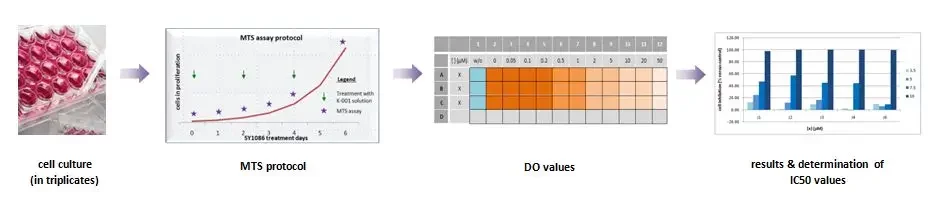
Experimental workflow for AnyGenes® in vitro drug-response studies

Experimental conditions can be progressively refined from cell-based response measurements toward complementary molecular analyses.

Research context: responses observed in an in vitro model provide experimental evidence under defined biological conditions. They do not, by themselves, establish clinical efficacy, safety or patient-level therapeutic response.

Human cell-line models

AnyGenes has access to a collection of human cell-line models that can be considered based on biological relevance, availability and project requirements.

Proliferation and functional assays

Cell proliferation and other selected functional assays can be used to characterize treatment-associated effects and compare defined experimental conditions.

Dose-response and IC50

Multiple compound concentrations can be tested to characterize concentration-dependent effects and, when appropriate, estimate IC50 values within the selected cellular model.

Replicates and quality controls

Standard cell-based drug-response conditions are performed in triplicate with appropriate experimental controls.

Interpreting IC50: an IC50 value depends on the cellular model, assay endpoint, exposure time and experimental conditions.
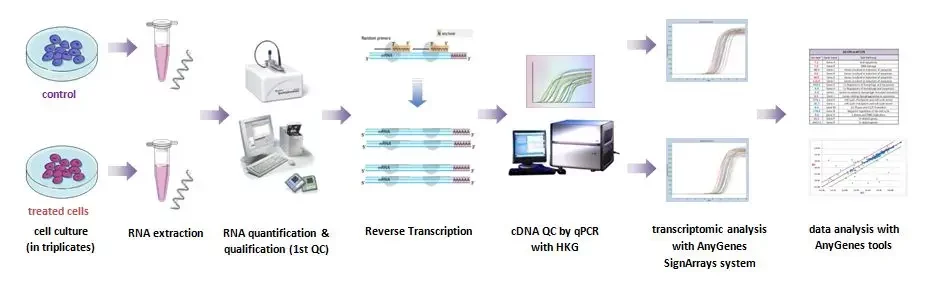
From dose-response and IC50 to molecular investigation

Dose-response experiments and IC50 values can help define relevant compound concentrations and treatment conditions for downstream molecular studies. Once a cellular response has been characterized, selected experimental conditions can be investigated at the molecular level to examine treatment-associated gene expression changes, signaling pathways and candidate biomarker signatures.

Selecting treatment conditions

Dose-response information can guide the selection of compound concentrations and exposure times for subsequent molecular analyses, according to the biological question and observed cellular response.

Pathway-focused qPCR analysis

Samples generated from selected experimental conditions can be analyzed using targeted quantitative real-time PCR and pathway-focused SignArrays®. These panels enable focused investigation of genes associated with selected signaling pathways and biological processes.

Molecular signatures and candidate biomarkers

Comparison of defined experimental conditions can help identify treatment-associated gene expression patterns, molecular signatures and candidate biomarkers for further investigation.

Mechanistic interpretation: cell-based responses combined with targeted gene expression and pathway analysis can contribute to investigating molecular mechanisms associated with treatment. These data do not, by themselves, establish a complete mechanism of action or predict clinical response.


Depending on the scope of the project, AnyGenes® can coordinate the experimental workflow from cell-based treatment and sample processing to targeted molecular analysis and data interpretation.

Workflow linking in vitro drug-response analysis with qPCR pathway profiling and biomarker investigation

An integrated in vitro drug development workflow

The experimental workflow can connect the biological question, cellular response measurements and targeted molecular follow-up within the same research project.

01

Define the project

Define the compound, biological question, cellular model and experimental comparisons.

02

Establish treatment conditions

Select concentrations, exposure times, controls and replication strategy.

03

Measure cellular response

Characterize proliferation or other selected functional responses and generate dose-response data.

04

Select molecular follow-up conditions

Use cellular-response and IC50 information, when relevant, to select conditions for downstream analysis.

05

Investigate molecular responses

Examine selected genes, pathways and treatment-associated molecular signatures using targeted molecular approaches.

Flexible project design: not every project requires all five stages. A study can begin from an experimental compound, existing response data, established treatment conditions or samples requiring molecular follow-up.

What can an in vitro drug-response project start from?

The starting point can vary depending on how far the experimental project has already progressed.

Experimental compound

One or more experimental compounds requiring evaluation in an appropriate cellular model.

Biological question and preferred model

A defined research objective and, when available, a preferred cell-line model can help guide the experimental strategy.

Existing response data or treatment conditions

Preliminary proliferation, dose-response, IC50 or other experimental data can provide a starting point for subsequent studies.

Candidate genes, pathways or molecular samples

Existing molecular targets, pathways or samples generated under defined treatment conditions can be incorporated into targeted qPCR follow-up.

Published research using AnyGenes® technologies in treatment-response studies

Peer-reviewed research provides an example of how targeted AnyGenes gene expression technologies have been incorporated into studies of treatment response and resistance.

Biochemical Pharmacology · 2026

lncRNA profiling during methotrexate response and resistance

A study investigating the transition from early methotrexate response to resistance in HT29 colorectal cancer cells incorporated targeted lncRNA profiling using the AnyGenes Human LncRNA and Cancer SignArray®.


AnyGenes® technologies used: Human LncRNA and Cancer SignArray® · StaRT Reverse Transcription Kit · SignArray® data analysis software

Frequently asked questions about in vitro drug development services

Common questions about cell-based drug-response studies, IC50 analysis and molecular follow-up.

What are in vitro drug development services?

In vitro drug development services use experimental cellular models to investigate how cells respond to defined compounds or treatment conditions. Depending on the project, cell-based response assays can be combined with targeted molecular analysis to examine treatment-associated gene expression changes.

Can AnyGenes determine IC50 values?

IC50 determination can be incorporated into appropriate dose-response experiments using selected cellular models. The concentration range, treatment duration and measured endpoint should be defined according to the compound and research objective.

Can SignArrays® be used to investigate treatment response?

Yes. SignArrays® provide focused qPCR panels for selected signaling pathways and biological processes and can support comparison of transcriptional responses between defined experimental conditions.

Can these experiments determine a mechanism of action?

Cellular and targeted molecular analyses can contribute to investigating biological mechanisms associated with an experimental response. However, results should be interpreted within the limits of the selected model and do not, by themselves, establish a complete mechanism of action or clinical response.

Which cell lines can be used?

AnyGenes has access to a collection of human cell-line models for in vitro research. The appropriate model should be selected based on biological relevance, availability and project requirements.

Need an in vitro strategy for your experimental compound?

Tell us about your compound, biological question, preferred cellular model, treatment conditions or existing experimental data. Our scientific team can discuss an appropriate cell-based strategy and determine whether targeted molecular analysis could complement your study.