Adipogenesis – Mechanisms of Adipocyte Differentiation and Biomarker Analysis
What is adipogenesis ?
Adipogenesis is the biological process through which precursor cells known as pre-adipocytes differentiate into mature adipocytes (fat cells) capable of storing lipids and secreting endocrine factors. This process plays a central role in energy homeostasis, metabolic regulation, and endocrine signaling.
Adipocyte differentiation involves a complex transcriptional cascade that controls the commitment of mesenchymal stem cells to the adipocyte lineage and their maturation into lipid-accumulating cells. These events are tightly regulated by transcription factors and signaling pathways that coordinate gene expression programs associated with lipid metabolism and adipokine production.
Among the most important regulators of adipogenesis are the transcription factors peroxisome proliferator-activated receptor gamma (PPARγ) and CCAAT/enhancer-binding proteins (C/EBPα, C/EBPβ, and C/EBPδ). These factors activate adipocyte-specific genes involved in lipid storage, insulin sensitivity, and metabolic homeostasis..
The molecular activity of adipogenesis can be investigated through gene expression profiling of adipogenic transcription factors and metabolic genes, enabling researchers to monitor adipocyte differentiation and metabolic remodeling
Adipogenesis is the process of differentiation of precursor cells into adipocytes
The transcription factors PPARγ and C/EBP family proteins are master regulators of adipocyte differentiation
Adipose tissue acts as both an energy storage organ and endocrine regulator
Dysregulated adipogenesis contributes to obesity, metabolic diseases, and cancer progression
Gene expression profiling provides valuable insights into adipogenesis mechanisms
Molecular regulation of adipogenesis
Transcriptional regulators of adipocyte differentiation
Adipocyte differentiation is orchestrated by a hierarchical network of transcription factors.
Early in the adipogenic process, the transcription factors C/EBPβ and C/EBPδ become activated and induce expression of PPARγ and C/EBPα, which serve as master regulators of adipocyte differentiation.
These transcription factors promote the expression of adipocyte-specific genes involved in lipid metabolism, including:
FABP4 (fatty acid binding protein 4)
Adiponectin (ADIPOQ)
Fatty acid synthase (FASN)
These genes regulate lipid uptake, triglyceride synthesis, and metabolic functions associated with mature adipocytes.
Other transcription factors also contribute to adipogenesis. Members of the Krüppel-like factor (KLF) family, including KLF4, KLF5, KLF9, and KLF15, have been shown to promote adipocyte differentiation in cellular models such as 3T3-L1 pre-adipocytes.
For example, ectopic expression of KLF15NIH 3T3 cells induces lipid accumulation and activates expression of PPARγ, highlighting its role in adipogenic regulation.
Signaling pathways influencing adipogenesis
Adipogenesis is modulated by several signaling pathways that regulate transcriptional activation and metabolic processes.
The transcription factor CREB (cAMP response element-binding protein) can promote adipogenesis by inducing triglyceride accumulation and expression of adipocyte marker genes such as PPARγ and FABP4.
Conversely, transforming growth factor-β (TGF-β) signaling acts as a negative regulator of adipocyte differentiation. TGF-β inhibits adipogenesis by suppressing transcriptional activity of C/EBP transcription factors, thereby preventing activation of adipogenic gene expression programs.
These regulatory mechanisms ensure that adipocyte differentiation occurs in response to appropriate physiological signals.
Types of adipose tissue
Adipose tissue exists in different forms with distinct metabolic and physiological functions.
White adipose tissue (WAT)
White adipose tissue is the most abundant adipose tissue in mammals and primarily functions as a storage depot for triglycerides.
It is distributed in several anatomical locations, including:
White adipocytes also function as endocrine cells that secrete signaling molecules such as:
leptin
adiponectin
cytokines and chemokines
These molecules regulate appetite, insulin sensitivity, inflammation, and systemic metabolism
Brown adipose tissue (BAT)
Brown adipose tissue is specialized in energy expenditure and thermogenesis.
It is located primarily in supraclavicular and cervical regions and contains adipocytes rich in mitochondria.
BAT contributes to heat production and metabolic regulation, particularly in response to cold exposure and nutritional stimuli. Genes involved in lipid metabolism and mitochondrial activity, including regulators such as SREBP1, are expressed in brown adipocytes
Adipogenesis and disease
Alterations in adipocyte differentiation contribute to several metabolic and pathological conditions.
Dysregulated adipogenesis is strongly associated with Metabolic disorders:
obesity
type 2 diabetes
metabolic syndrome
cardiovascular diseases
Abnormal adipose tissue expansion can disrupt lipid metabolism and insulin signaling pathways.
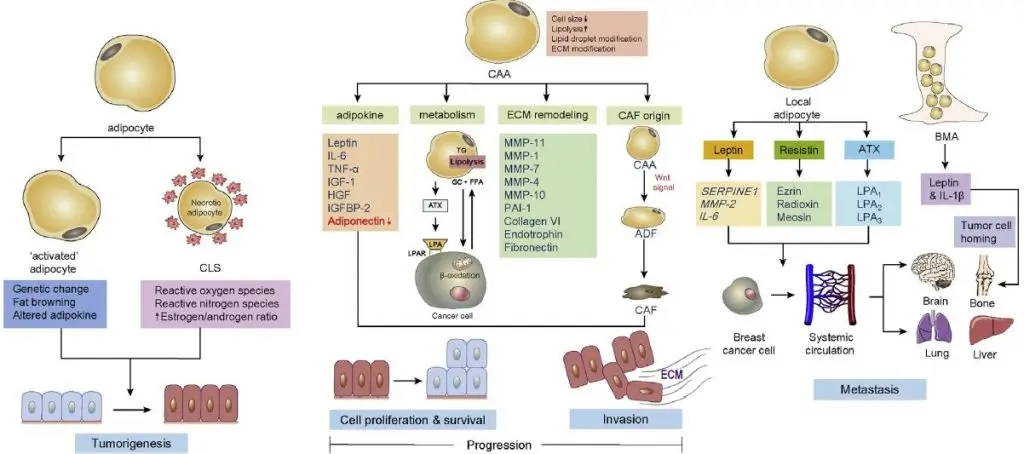
Adipocytes in the tumor microenvironment
Adipocytes can influence the tumor microenvironment and contribute to cancer progression.
In several solid tumors, including breast cancer, adipocytes interact with cancer cells and modulate tumor growth and invasion.
Adipocyte-derived molecules such as leptin and hepatocyte growth factor (HGF) can stimulate cancer cells to secrete matrix metalloproteinases (MMPs), which facilitate tumor invasion and metastasis.
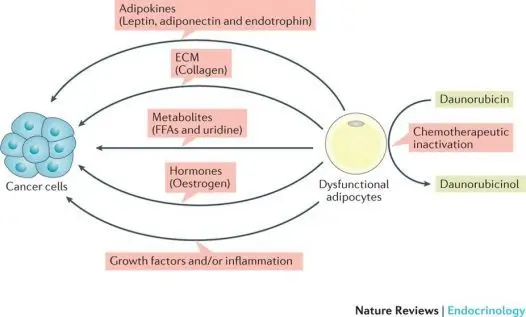
Recent studies have also shown that adipocytes may contribute to chemotherapy resistance. For example, adipocytes can metabolize the chemotherapeutic drug daunorubicin into a less active metabolite known as daunorubicinol, potentially reducing therapeutic efficacy
Role of adipocyte as an active facilitator in breast cancer initiation, progression and metastasi.
Adipose tissue effects in the tumour microenvironment.
Why study adipogenesis with AnyGenes®
Understanding adipocyte differentiation requires accurate and reproducible gene expression analysis.
AnyGenes® SignArrays® qPCR panels enable researchers to:
quantify key transcription factors involved in adipogenesis
monitor adipocyte differentiation signatures
analyze metabolic gene networks
generate reproducible gene expression datasets
These pathway-focused qPCR arrays provide a robust platform for studying adipogenesis in metabolic and translational research
Biomarker analysis with AnyGenes®
The Adipogenesis SignArrays® panel includes genes associated with:
adipocyte differentiation
lipid metabolism
adipokine secretion
metabolic signaling pathways
Available species: Homo sapiens,Mus musculus,Rattus norvegicus,Sus scrofa
Custom panels can also be designed to address specific research questions related to metabolic disorders or adipose tissue biology.
Analyze your pathway data with AnyGenes® software
Scientific data is only as powerful as the analysis behind it.
AnyGenes® provides a dedicated data analysis tool specifically developed for SignArrays® pathway panels.
What does it allow you to do?
Automated ΔCq calculation
Normalization with selected housekeeping genes
Comparison of up to 10 experimental conditions
Generation of descriptive statistics
Publication-ready graphs
Exportable tables for manuscripts and presentations
Developed on Excel (compatible with 2007+), the software is user-friendly and requires no advanced bioinformatics skills.
Adipogenesis is the biological process by which precursor cells differentiate into mature adipocytes capable of storing lipids and secreting metabolic hormones.
What transcription factors regulate adipogenesis?
The main regulators are PPARγ and C/EBP transcription factors, which activate adipocyte-specific gene expression programs.
What is the role of adipose tissue in metabolism?
Adipose tissue stores energy as triglycerides and functions as an endocrine organ that secretes hormones such as leptin and adiponectin.
Why is adipogenesis important in metabolic diseases?
Dysregulated adipogenesis contributes to obesity, insulin resistance, and metabolic syndrome.
How can adipogenesis be studied experimentally?
Adipogenesis can be analyzed through gene expression profiling of adipocyte markers and transcription factors using targeted qPCR arrays.
Adipogenesis signaling pathway biomarker list
You can check the biomarker list included in this pathway, see below:
Looking for more answers? Visit our Help & FAQ section to find detailed informations about our products, services, and technical support.
Bibliography
1. Moseti D et al. Molecular Regulation of Adipogenesis and Potential Anti-Adipogenic Bioactive Molecules. Int J Mol Sci. (2016) 19;17(1).
2. Han J et al. Regulation of Adipogenesis Through Differential Modulation of ROS and Kinase Signaling Pathways by 3,4'-Dihydroxyflavone Treatment. J Cell Biochem. (2017);118(5):1065-1077.
3. Zhang Z1 & Scherer PE. Adipose tissue: The dysfunctional adipocyte - a cancer cell's best friend. Nat Rev Endocrinol. (2018);14(3):132-134.
4. Duong MN et al. The fat and the bad: Mature adipocytes, key actors in tumor progression and resistance. Oncotarget. (2017).
5. Choi J et al. Adipocyte biology in breast cancer: From silent bystander to active facilitator. Prog Lipid Res. (2018);(69):11-20.
Need pricing information or distributor details?
For quotations, product information, or project discussions, please contact our team at
[email protected].