JAK-STAT Signaling Pathway – Functions, Disease Implications and Biomarker Analysis
What is JAK-STAT signaling pathway?
The JAK-STAT signaling pathway (Janus Kinase / Signal Transducer and Activator of Transcription) is a fundamental intracellular signaling cascade that directly links extracellular cytokines and growth factors to nuclear gene expression.
This pathway plays a central role in immune responses, cell proliferation, differentiation, angiogenesis, and apoptosis. Because of its simplicity and speed – signal transmission from membrane to nucleus – JAK-STAT signaling is essential for rapid cellular responses.
Dysregulation of JAK-STAT signaling is strongly associated with autoimmune diseases, chronic inflammation, cancer, and hematological disorders, making it a major focus in biomedical and translational research.
JAK-STAT pathway activity can be efficiently assessed through targeted gene expression analysis of pathway regulators and downstream transcriptional targets.
The schematic structures of the JAK and STAT proteins and overview of the JAK/STAT pathway
AMPK substrates act in specific subcellular locales to rewire metabolism.
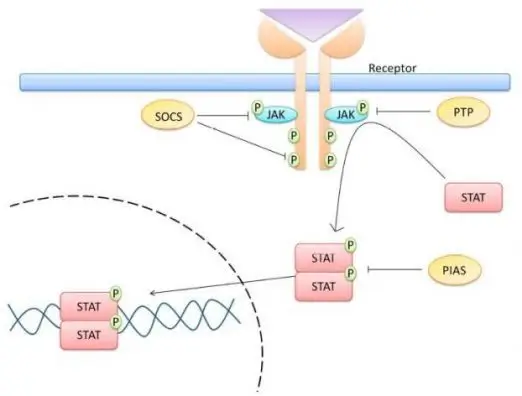
Janus kinase (JAK)/signal transducer and activator of transcription (STAT) signaling pathway. Membrane cytokine receptors have cytoplasmic tails in which inactive JAKs associate constitutively. The interaction of cytokines or growth factors with their receptors (type I and II) induces dimerization/oligomerization of these receptors. It should be mentioned that some cytokine receptors, such as GHR and EpoR, show pre-formed dimers. In both cases, the interaction between the cytokine and its receptor induces a conformational change in the cytoplasmic domain.
This interaction results in the juxtaposition of JAKs, leading to their autophosphorylation or transphosphorylation by other JAKs or other families of tyrosine kinases. The activated JAKs then phosphorylate the receptor’s cytoplasmic tails on tyrosine residues, creating sites that allow the binding of other signaling molecules that contain an SH2 domain (such as STAT proteins). Cytoplasmic STATs then bind to phosphorylated receptors, becoming substrates for JAKs, which phosphorylate STATs on highly conserved tyrosine residues.
After their phosphorylation, STATs form homodimers or heterodimers that are capable of translocating to the nucleus and activating gene transcription. The JAK/STAT pathway is negatively regulated by the suppressors of cytokine signaling (SOCS), as well as by the protein inhibitor of activated STAT (PIAS) and protein tyrosine phosphatases (PTPs).
Key takeaways – JAK-STAT pathway
Direct signaling route from cytokine receptors to the nucleus
Core regulators of immune and inflammatory responses
Built around JAK kinases and STAT transcription factors
Frequently dysregulated in cancer and autoimmune diseases
Highly suitable for targeted gene expression and biomarker analysis
Core components of the JAK-STAT pathway
Janus Kinases (JAKs)
The JAK family consists of JAK1, JAK2, JAK3, and TYK2, non-receptor tyrosine kinases constitutively associated with cytokine receptors.
Signal Transducers and Activators of Transcription (STATs)
STAT proteins (STAT1, STAT2, STAT3, STAT4, STAT5A, STAT5B, STAT6) act as transcription factors activated downstream of JAKs.
Cytokine receptors
Type I and II cytokine receptors lack intrinsic kinase activity and rely on JAKs for signal transduction.
Negative regulators
JAK-STAT signaling is tightly regulated by:
SOCS (Suppressors of Cytokine Signaling)
PIAS (Protein Inhibitors of Activated STAT)
Protein tyrosine phosphatases (PTPs)
Mechanism of JAK-STAT pathway activation
Activation begins when cytokines, hormones, or growth factors bind to their receptors, inducing receptor dimerization or conformational changes.
This leads to:
JAK autophosphorylation or transphosphorylation
Phosphorylation of receptor cytoplasmic tails
Recruitment and phosphorylation of STAT proteins
STAT dimerization (homo- or heterodimers)
Nuclear translocation of STAT dimers
Activation of target gene transcription
Negative feedback mechanisms prevent excessive or prolonged signaling.
Immune responses: Cytokine-driven activation of innate and adaptive immunity.
Cell proliferation and survival: Regulation of growth and anti-apoptotic gene expression.
Cell differentiation: Especially in hematopoietic and immune lineages.
Inflammation: Control of inflammatory mediators and cytokine signaling loops.
Host defense and stress responses
JAK-STAT signaling pathway in disease
Cancer and tumor progression
Persistent activation of STAT3 and STAT5 promotes tumor cell survival, proliferation, immune evasion, and metastasis in many solid and hematological cancers.
The JAK-STAT pathway transmits signals from cytokines and growth factors to the nucleus, regulating gene expression involved in immune responses, cell growth, and survival.
By measuring expression levels of pathway regulators and downstream targets using targeted qPCR pathway arrays.
Xin P, et al. The role of JAK/STAT signaling pathway and its inhibitors in diseases. Int Immunopharmacol. (2020);80:106210.
Cordes F, et al. Differential regulation of JAK/STAT-signaling in patients with ulcerative colitis and Crohn’s disease. World J Gastroenterol. (2020);26(28):4055-4075.
Gutiérrez-Hoya A, & Soto-Cruz I. Role of the JAK/STAT Pathway in Cervical Cancer: Its Relationship with HPV E6/E7 Oncoproteins. Cells. (2020);9(10):2297.
Goker Bagca B, & Biray Avci C.The potential of JAK/STAT pathway inhibition by ruxolitinib in the treatment of COVID-19. Cytokine Growth Factor Rev. (2020);54:51-62.
Shao F, et al. Targeting the JAK/STAT Signaling Pathway for Breast Cancer. Curr Med Chem. (2021);28(25):5137-5151.
JAK-STAT signaling pathway biomarker list
You can check the biomarker list included in this pathway, see below: