Altered cell physiology
Mycoplasma contamination can affect cell proliferation, metabolism and cellular morphology, potentially changing the biological properties of cultured cells.

A mycoplasma test kit helps laboratories detect contamination that can affect cell culture experiments without producing obvious visible signs. Routine screening supports cell culture quality control and more reliable experimental interpretation.
AnyGenes® MycoDiag® uses real-time qPCR or end-point PCR to detect mycoplasma DNA directly from cell culture supernatants. The assay targets 25 organisms associated with cell culture contamination and supports routine laboratory screening.
Mycoplasmas are small bacteria that lack a cell wall and can contaminate cell cultures without producing obvious visible signs. Undetected contamination may alter cellular behavior and compromise experimental results.
Mycoplasma contamination can affect cell proliferation, metabolism and cellular morphology, potentially changing the biological properties of cultured cells.

Mycoplasma contamination can alter cellular gene expression, signaling pathways and inflammatory responses. These biological changes may introduce bias into qPCR, RNA-seq and biomarker studies, potentially affecting the interpretation of experimental results.
Mycoplasma contamination may reduce transfection efficiency, alter cellular phenotypes and introduce biological variability that affects experimental reproducibility.
Why routine testing matters: Because mycoplasma contamination may remain unnoticed during routine observation, regular screening helps laboratories identify affected cell cultures and reduce the risk of misleading experimental conclusions.
PCR-based methods detect mycoplasma DNA in cell culture samples. The AnyGenes® MycoDiag® mycoplasma test kit uses targeted DNA amplification to detect selected mycoplasma species directly from cell culture supernatants.
Cell culture supernatants are analyzed using the appropriate MycoDiag® protocol, enabling detection of mycoplasma DNA without relying on visible signs of contamination.
Targeted DNA sequences are amplified using compatible PCR assays. Real-time qPCR monitors amplification during the reaction, while end-point PCR products can be examined by agarose gel electrophoresis.
Positive and negative controls help verify assay performance and monitor contamination. An internal control helps identify PCR inhibition that could compromise the interpretation of negative results.
Review the main technical characteristics of the AnyGenes® MycoDiag® kit to identify the detection method, sample requirements and instrument configuration suited to your laboratory.
Kit contents: MycoDiag® includes targeted primer sets, amplification reagents and assay controls, according to the selected catalog reference. Refer to the user guide for the complete reagent list and quantities.
Real-time qPCR or end-point PCR for targeted detection of mycoplasma DNA.
Cell culture supernatants, analyzed according to the MycoDiag® protocol.
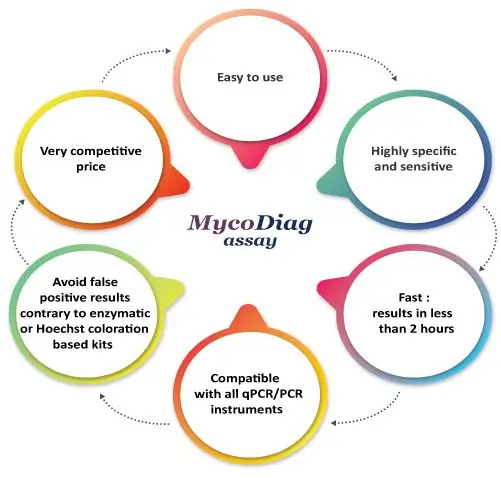
Results in under 2 hours under the specified assay conditions, depending on the PCR or qPCR instrument.
Targets 25 organisms associated with mycoplasma contamination of cell cultures, including representative Mycoplasma species and related organisms.
Positive, negative and internal controls support assay verification, contamination monitoring and the identification of PCR inhibition.
Different kit configurations are available for compatible real-time qPCR instruments and end-point PCR workflows. Select the appropriate reference using the compatibility guide.
Mycoplasma screening should be integrated into routine cell culture quality control, with additional testing at key stages of the experimental workflow. The appropriate schedule depends on the cell lines, laboratory procedures and contamination risk.
Check cultures before experiments where undetected contamination could affect data interpretation, particularly:
Test cultures at important stages of cell line handling, including:
Newly received cell lines should be screened before introduction into clean culture areas.
Perform periodic mycoplasma testing according to laboratory quality control procedures, and consider additional screening when:
Testing frequency: Establish a documented screening schedule based on the laboratory's contamination risk, cell culture practices and experimental needs. Routine testing should not be limited to cultures showing visible abnormalities.
MycoDiag® targets DNA from 25 organisms associated with cell culture contamination. Its qPCR and end-point PCR protocols include quality controls to support assay verification and result interpretation.
Detection scope: MycoDiag® targets the 25 organisms listed above. A negative result does not exclude organisms outside the assay's detection scope.
MycoDiag® includes positive, negative and internal controls to help verify amplification, monitor potential contamination and identify PCR inhibition.
Mycoplasma DNA control (Myco POS) used to verify the expected amplification response of the assay.
No-template control used to monitor possible contamination during PCR or qPCR preparation.
A separate control reaction helps identify PCR inhibition that could affect interpretation of negative samples.
MycoDiag® results can be examined using real-time amplification curves or agarose gel electrophoresis. Results should be interpreted alongside the assay controls.
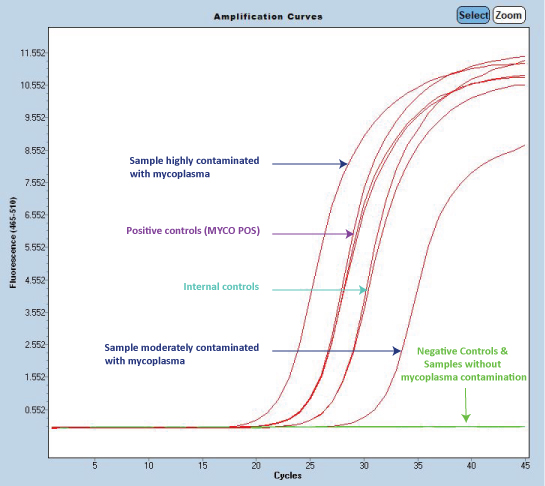
Result interpretation: Negative results should be evaluated alongside valid assay controls. For end-point PCR, the MycoDiag® user guide specifies positive-control products of 129–142 bp and an internal-control product of 92 bp.
Consult the MycoDiag® user guide for the complete protocol, expected control results and interpretation criteria.
Intended use: For molecular biology research use only. Not intended for diagnostic or therapeutic use.
MycoDiag® is available in three kit sizes to accommodate different laboratory testing requirements. Select the number of reactions and the configuration compatible with your PCR or qPCR instrument.
| Catalog Reference | Number of Reactions | Price (before TAX) |
|---|---|---|
X : W, R, LR, F, according to the qPCR instrument or P for EndPoint PCR application (Please see our compatibility file)
Pricing: Contact AnyGenes® for a quotation based on the selected kit format and configuration.
In the catalog references above, X indicates the assay configuration: W, R, LR or F for compatible real-time qPCR instruments, or P for end-point PCR applications.
Feedback from a laboratory using MycoDiag® for routine mycoplasma contamination monitoring.

Bicêtre Hospital
AP-HP, Paris-Saclay
“Our lab has been using the MycoDiag reagent for over a year to monitor Mycoplasma contamination. We appreciate the consistent quality and excellent support from AnyGenes.”
Dr Élise Lebigot
Biologist, Biochemistry Department
Bicêtre Hospital, AP-HP, Paris-Saclay
A mycoplasma test kit is used to detect mycoplasma contamination in biological samples. The AnyGenes® MycoDiag® kit uses real-time qPCR or end-point PCR to detect targeted bacterial DNA directly from cell culture supernatants.
Mycoplasma contamination can be detected using PCR-based methods, microbial culture or other suitable testing approaches. MycoDiag® detects targeted bacterial DNA by qPCR or end-point PCR, using appropriate controls to support result interpretation.
Yes. Mycoplasma contamination can alter gene expression, cellular metabolism and responses associated with inflammation or cell growth. These changes may affect the interpretation of qPCR, RNA-seq and biomarker research results.
MycoDiag® can provide results in less than 2 hours when performed under the specified assay conditions. The total analysis time depends on the PCR or qPCR instrument and the experimental workflow.
Cell cultures should be tested regularly according to laboratory quality control procedures and contamination risk. Additional screening is recommended when introducing new cell lines, recovering cryopreserved cultures or preparing important experiments.
MycoDiag® targets 25 organisms associated with cell culture contamination, including M. hyorhinis, M. orale, M. fermentans, M. arginini, M. hominis, Acholeplasma laidlawii, Spiroplasma and Ureaplasma urealyticum. The complete list is provided in the detection coverage section.
Yes. MycoDiag® is available in configurations for compatible real-time qPCR instruments and end-point PCR workflows. The appropriate kit reference should be selected using the MycoDiag® instrument compatibility information .
Yes. MycoDiag® is intended for research applications involving routine mycoplasma contamination screening in cell cultures. It can support laboratory quality control workflows in molecular biology and biotechnology research.
Looking to introduce routine mycoplasma screening or select a MycoDiag® kit compatible with your PCR or qPCR instrument? Contact AnyGenes® for pricing, technical information and assistance in choosing the appropriate kit configuration.