Hi, Continue visiting your profile
user

Login

Email

Password

Create account
Forget password
AnyGenes
  • email login

Reverse transcription kits for reliable first-strand cDNA synthesis

AnyGenes® StaRT Reverse Transcription Kits are designed to support efficient first-strand cDNA synthesis from RNA samples before qPCR, qPCR arrays and targeted gene expression analysis.

Optimized for a broad RNA input range, from 5 ng to 2 µg RNA depending on the experimental setup, StaRT kits help researchers prepare high-quality cDNA for downstream transcriptomic workflows.
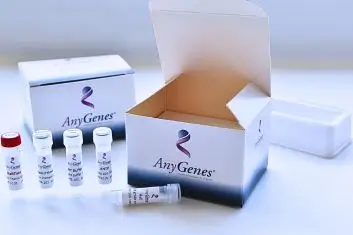
Reverse transcription kits First-strand cDNA synthesis 5 ng to 2 µg RNA qPCR ready
AnyGenes StaRT Reverse Transcription Kits for first-strand cDNA synthesis and qPCR gene expression analysis

StaRT Reverse Transcription Kits at a glance

StaRT Reverse Transcription Kits are designed for researchers who need a robust reverse transcription step before qPCR, qPCR arrays, biomarker analysis or pathway-focused gene expression studies.

Broad RNA input range

Supports reverse transcription workflows using 5 ng to 2 µg RNA, depending on sample quality, target abundance and downstream analysis.

First-strand cDNA synthesis

Converts RNA into first-strand cDNA suitable for downstream real-time PCR and targeted gene expression workflows.

qPCR and qPCR arrays

Designed for compatibility with standard qPCR assays, SignArrays® panels and targeted transcriptomic analysis.

Sample type flexibility

Can support workflows involving RNA from cell lines, tissues, PBMCs, FFPE-derived samples or LCM samples.

Challenging RNA sequences

Supports reverse transcription workflows involving selected AU-rich or GC-rich RNA regions, depending on assay design and sample quality.

Complete AnyGenes® workflow

Can be combined with SpeAmp® preamplification, validated qPCR primers, Master Mixes and SignArrays® panels.

A reverse transcription workflow for qPCR and gene expression analysis

Reverse transcription is a critical upstream step in qPCR-based gene expression analysis. The quality and consistency of cDNA synthesis can influence downstream Cq values, target detection and biological interpretation.

StaRT Reverse Transcription Kits are designed to support a streamlined workflow from RNA input to first-strand cDNA synthesis, followed by qPCR, qPCR arrays or targeted transcriptomic analysis.

1. RNA input

RNA is prepared from the selected biological material and assessed according to the requirements of the downstream experiment.

2. Reverse transcription

StaRT reagents support the conversion of RNA into first-strand cDNA for downstream amplification.

3. qPCR analysis

The generated cDNA can be used for qPCR assays, SignArrays® qPCR arrays or selected gene expression workflows.
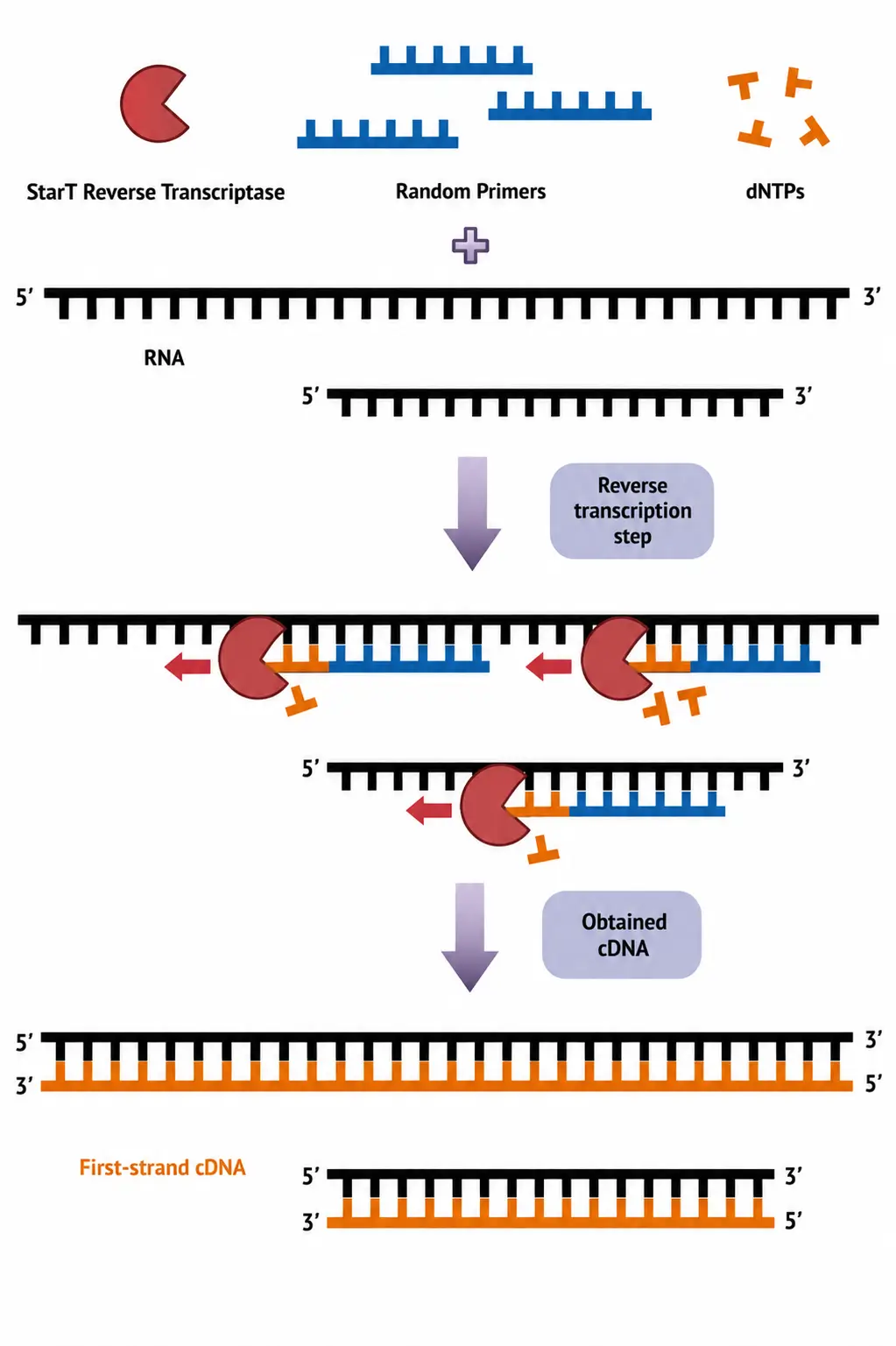
Reverse transcription workflow showing RNA primers dNTPs reverse transcriptase and first-strand cDNA synthesis
Schematic representation of reverse transcription from RNA to first-strand cDNA before downstream qPCR analysis.
Reverse transcription performance depends on RNA quality, input amount, sample type, primer strategy, target abundance and downstream qPCR conditions.

Quality-controlled reverse transcription performance

AnyGenes® has evaluated the StaRT Reverse Transcription workflow using qPCR quality control experiments designed to assess repeatability and amplification efficiency after cDNA synthesis.

These validation data support the use of StaRT kits in gene expression workflows, including qPCR assays, SignArrays® qPCR arrays and low-input transcriptomic applications.
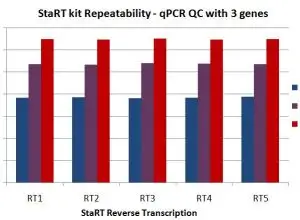
Repeatability across reverse transcription reactions

StaRT Reverse Transcription kit repeatability graph showing qPCR quality control with three genes
qPCR quality control data showing repeatability across StaRT Reverse Transcription reactions.

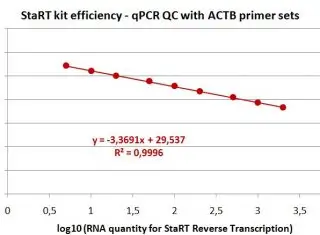
Efficiency across RNA input quantities

StaRT Reverse Transcription kit efficiency graph showing qPCR quality control with ACTB primer sets
qPCR quality control data showing amplification efficiency across RNA input quantities after StaRT Reverse Transcription.
Validation highlight: R² = 0.9996 in selected ACTB qPCR quality control experiments.
Reverse transcription performance depends on RNA quality, RNA input, sample type, reverse transcription conditions, primer strategy, target abundance and downstream qPCR assay design.

Reverse transcription kits for diverse sample types

StaRT Reverse Transcription Kits can be used in gene expression workflows involving routine samples as well as more challenging or precious biological material.

Cell lines

Supports routine reverse transcription workflows for qPCR-based gene expression studies.

Tissues

Can be used with RNA extracted from tissue samples when RNA quality is suitable for downstream analysis.

PBMC samples

Supports workflows involving immune cell samples and targeted transcript analysis.

FFPE-derived RNA

Can support selected workflows involving fragmented or challenging RNA when assay design is adapted.

LCM samples

Suitable for workflows involving limited material from laser capture microdissection, depending on RNA quality and input.

Low-input samples

Can be combined with downstream SpeAmp® preamplification when input material or target abundance is limited.

Applications of StaRT Reverse Transcription Kits

StaRT Reverse Transcription Kits support the upstream cDNA synthesis step in a wide range of qPCR and transcriptomic workflows.

Gene expression analysis

Prepare cDNA for targeted quantification of selected genes, transcripts or biological signatures.

qPCR experiments

Generate first-strand cDNA for downstream real-time PCR assays and relative expression analysis.

SignArrays® qPCR arrays

Use StaRT-generated cDNA for pathway-focused qPCR array workflows and biomarker panels.

RNA-seq validation

Support targeted qPCR validation of selected transcriptomic results after RNA-seq analysis.

Biomarker research

Analyze selected gene signatures in research projects focused on biomarkers or signaling pathways.

Low-input qPCR workflows

Combine reverse transcription with SpeAmp® preamplification when starting material or target abundance is limited.

Build a complete qPCR gene expression workflow

StaRT Reverse Transcription Kits can be integrated with complementary AnyGenes® qPCR solutions to support targeted gene expression analysis from RNA input to data interpretation.

SpeAmp® preamplification

Use SpeAmp® when input material is limited or when selected targets are weakly expressed.

Validated qPCR primers

Analyze selected genes using experimentally validated qPCR primer sets.

SignArrays® panels

Profile selected signaling pathways or build personalized qPCR panels.

StaRT Reverse Transcription Kits catalog

StaRT Reverse Transcription Kits are available in different reaction formats. Contact AnyGenes® for quotations, product information, distributor details or technical guidance.

Catalog Reference Number of Reactions Price (before TAX)
StaRT-10
10
***
StaRT-25
25
***
StaRT-50
50
***

Need support with reverse transcription and qPCR analysis?

AnyGenes® can help you select the appropriate reverse transcription, preamplification, qPCR assay and SignArrays® workflow according to your RNA input, sample type, target genes and research objectives.

Whether your project involves gene expression analysis, biomarker research, RNA-seq validation, qPCR arrays or low-input samples, our team can help you define a targeted qPCR strategy.

Frequently asked questions about reverse transcription kits

What are reverse transcription kits used for?

Reverse transcription kits are used to convert RNA into complementary DNA, or cDNA, before downstream qPCR, qPCR array or gene expression analysis.

What RNA input range can be used with StaRT Reverse Transcription Kits?

StaRT Reverse Transcription Kits can support workflows using 5 ng to 2 µg RNA, depending on sample quality, input availability and downstream qPCR requirements.

Can StaRT kits be used before qPCR arrays?

Yes. StaRT-generated cDNA can be used in adapted qPCR array workflows, including AnyGenes® SignArrays® panels for pathway-focused gene expression analysis.

Can StaRT kits be used with FFPE or LCM samples?

StaRT kits can support selected workflows involving FFPE-derived RNA or LCM samples, provided that RNA quality, input amount and assay design are adapted to the project.

Can reverse transcription be combined with SpeAmp® preamplification?

Yes. StaRT reverse transcription can be followed by SpeAmp® cDNA preamplification when input material is limited or selected targets are weakly expressed.

Can AnyGenes® help optimize a reverse transcription workflow?

Yes. AnyGenes® can help adapt the workflow according to RNA input, sample type, target genes, preamplification needs and downstream qPCR analysis.

Need more technical answers?

Visit the AnyGenes® Help & FAQ section for detailed information about our products, services, ordering process and technical support.

Visit Help & FAQ