


Purpose
Independently assess selected lncRNA expression changes identified by RNA-seq or other transcriptomic analyses.

lncRNA RNA-seq validation using targeted RT-qPCR helps researchers independently assess selected long non-coding RNA expression findings, evaluate differential expression trends and prioritize candidates for further investigation.
Because lncRNAs often exhibit low expression levels, complex transcript isoforms or overlap with other genomic regions, reliable quantification requires carefully selected assays that account for transcript specificity, sample quality and experimental design.
A successful validation strategy combines candidate selection, transcript-specific assay design and experimental conditions adapted to the biological samples being studied.
Independently assess selected lncRNA expression changes identified by RNA-seq or other transcriptomic analyses.
Targeted RT-qPCR using suitable lncRNA assays, transcript-specific primer sets or customized qPCR panels.
Transcriptomic follow-up, biomarker candidate investigation and targeted analysis of lncRNA expression patterns.
Low transcript abundance, isoform complexity, genomic overlap and limited RNA quantity or quality.
lncRNA qPCR assays, transcript-specific primers, custom qPCR panels and complementary gene expression reagents.
SpeAmp® targeted cDNA pre-amplification may support selected low-input workflows, provided assay performance is evaluated under the chosen experimental conditions.
RNA-seq enables transcriptome-wide discovery, but the reliability of individual expression estimates can vary with transcript abundance, annotation and analytical workflow. Targeted RT-qPCR offers a complementary approach for examining selected findings.
Targeted RT-qPCR allows researchers to independently measure selected lncRNA targets using a different analytical approach from RNA-seq.
With appropriate assay specificity, controls and normalization, it can help assess whether selected expression differences show consistent trends across the samples being investigated.
The assay must target a transcript region consistent with the RNA-seq finding, particularly when multiple isoforms or overlapping transcripts are involved.
Scientific evidence: Benchmarking studies comparing RNA-seq with RT-qPCR have reported generally consistent gene expression measurements, while identifying discrepancies for some transcripts, particularly those expressed at low levels. Everaert et al., 2017 examined protein-coding genes, whereas Assefa et al., 2018 specifically reported limitations in differential expression analysis of lncRNAs.
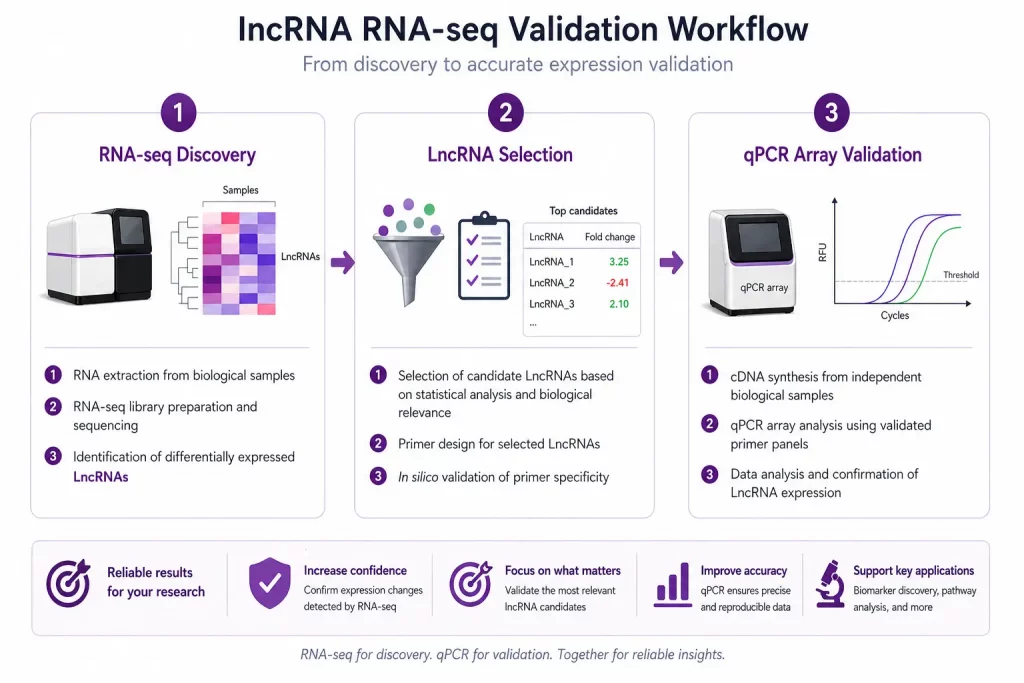
A reliable RT-qPCR follow-up workflow combines informed candidate selection, transcript-aware assay design, sample quality control and appropriate data analysis to assess selected RNA-seq expression findings.
Prioritize transcripts based on expression changes, adjusted statistical significance (FDR), transcript abundance and biological relevance.
Examine transcript isoforms, exon structure and genomic overlap to identify the appropriate region for targeted measurement.
Select a suitable lncRNA assay or design transcript-aware primers, verifying target specificity and amplification performance.
Assess RNA quantity and integrity, control genomic DNA contamination and use a consistent reverse transcription procedure.
Measure selected lncRNA targets with appropriate replicates and controls, using a normalization strategy supported by stable reference genes.
Evaluate the direction and consistency of expression changes, accounting for differences in assay targets, normalization and measurement methods.
Important: RNA-seq and RT-qPCR use different measurement approaches, so identical fold changes should not be expected. Agreement in expression direction supports selected RNA-seq findings, but interpretation should also consider assay performance, biological variability and statistical uncertainty.
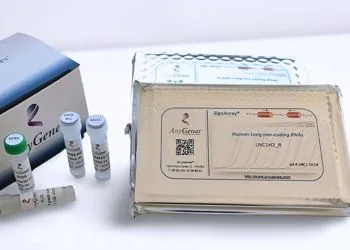
AnyGenes® offers lncRNA qPCR assays, flexible panel formats and complementary reagents to help researchers investigate selected RNA-seq candidates, from individual transcripts to customized target panels.
Experimentally validated assays for targeted lncRNA expression analysis, with assay selection adapted to the transcript of interest and the experimental requirements.
Analyze multiple selected lncRNA targets using qPCR array formats suitable for focused expression profiling and RNA-seq follow-up.
Develop personalized panels from RNA-seq candidate lists, with target selection and panel composition adapted to the research objectives.
Select or develop primers considering transcript annotation, isoform structure and genomic overlap to support target-specific amplification.
Targeted cDNA pre-amplification for selected workflows involving limited sample input or low-abundance lncRNA targets.
Guidance on assay selection, custom panel configuration and qPCR workflow planning according to transcript characteristics and study requirements.
Low-abundance lncRNAs may generate weak or inconsistent RT-qPCR signals, particularly when few target molecules are available after reverse transcription.
These challenges may be amplified when working with limited biological material, FFPE-derived RNA or laser capture microdissection (LCM) samples, where RNA quantity or integrity can constrain downstream analysis.
Targeted cDNA pre-amplification increases the amount of selected amplifiable targets before qPCR and may support the analysis of transcripts that are difficult to measure directly.
SpeAmp® enables targeted cDNA pre-amplification using selected primer pools before downstream qPCR analysis.
It can be incorporated into low-input workflows or customized target panels when sufficient cDNA is not available for reliable direct quantification. Assay compatibility and performance should be evaluated for the selected lncRNA targets.
Explore SpeAmp® pre-amplificationExperimental consideration: Pre-amplification can introduce target-dependent amplification bias. Before comparing expression levels across samples, researchers should evaluate assay performance, apply consistent pre-amplification conditions and confirm that the selected targets remain suitable for quantitative analysis. Pre-amplification does not compensate for poor RNA integrity or inefficient reverse transcription.
Selected lncRNA expression findings can be investigated across disease models, biological pathways and independent sample cohorts, according to the objectives of each study.
Examine lncRNA expression candidates associated with tumor biology, molecular subtypes, treatment response or exploratory biomarker studies.
Assess selected lncRNA expression changes in immune cell activation, inflammatory responses and cytokine-related research models.
Investigate lncRNA expression patterns associated with vascular remodeling, cardiac stress and cardiovascular disease models.
Explore selected lncRNA candidates in neuronal differentiation, neuroinflammation and neurodegenerative disease models.
Examine lncRNA expression alongside selected signaling pathway genes and regulatory markers to investigate coordinated expression patterns.
Assess whether selected RNA-seq expression trends are reproducible in independent biological samples, when a separate validation cohort is available.
Even well-selected RNA-seq candidates can produce misleading RT-qPCR results if assay performance, experimental controls or data interpretation are overlooked. The following pitfalls deserve particular attention when analyzing lncRNAs.
Unverified primer specificity, amplification efficiency or quantification range can compromise expression measurements. Evaluate assay performance under the intended experimental conditions.
Closely related isoforms or overlapping transcripts may complicate target-specific measurement. Verify that the qPCR assay detects the transcript region relevant to the RNA-seq finding.
Residual genomic DNA can contribute to amplification signals, especially when exon-spanning primer design is not feasible. Evaluate DNA contamination using appropriate no-reverse-transcription controls.
Large expression changes based on very low read counts may be unreliable. Consider adjusted statistical significance, transcript abundance and biological relevance before prioritizing candidates.
Reference genes that vary across experimental groups can distort normalized expression results. Assess their stability in the relevant sample types and biological conditions.
Weak amplification signals or disagreement with RNA-seq do not necessarily invalidate a candidate. Examine detection limits, assay specificity and biological variability before drawing conclusions.
Interpretation matters: Agreement between RNA-seq and RT-qPCR should be assessed in light of assay performance, biological replicates and measurement uncertainty. A consistent expression trend can support a selected finding, but does not by itself establish biological function or clinical biomarker validity.
Practical answers to common questions about lncRNA candidate selection, targeted RT-qPCR, assay specificity and RNA-seq result interpretation.
Targeted RT-qPCR provides an independent measurement of selected lncRNA expression findings identified by RNA-seq. It can help assess the consistency of differential expression trends before further biological investigation. However, expression confirmation alone does not establish biological function or clinical biomarker validity.
Candidate selection should consider expression changes, adjusted statistical significance (FDR), transcript abundance and biological relevance. Transcript annotation and the feasibility of designing a specific RT-qPCR assay are also important.
Common challenges include low transcript abundance, multiple isoforms, overlapping genomic regions and limited RNA quality or quantity. These characteristics can complicate assay specificity, reliable quantification and normalization.
Conventional primer design principles apply to lncRNAs, but primer suitability depends on transcript structure and the intended target region. Specificity should be evaluated, particularly for overlapping transcripts or multiple isoforms, alongside amplification performance.
Yes, provided the target is detectable and the assay performs reliably within the relevant concentration range. Targeted cDNA pre-amplification, such as SpeAmp®, may be considered for selected low-input workflows, with appropriate evaluation of amplification bias.
Yes. AnyGenes® offers customized qPCR panels based on selected RNA-seq candidate lists. Panel configuration can be adapted to the lncRNA targets, assay availability and experimental requirements of the research project.
No. RNA-seq and RT-qPCR differ in measurement principles, target regions and normalization methods. Fold-change magnitudes may therefore differ. Interpretation should consider the direction of expression changes, assay performance and statistical uncertainty rather than expecting identical numerical results.
Share your selected lncRNA candidates or RNA-seq target list with AnyGenes®. Our team can help you identify suitable qPCR assays, configure custom panels and explore approaches for low-abundance transcripts or limited sample input.