LncRNA RNA-seq validation: how to confirm expression with qPCR
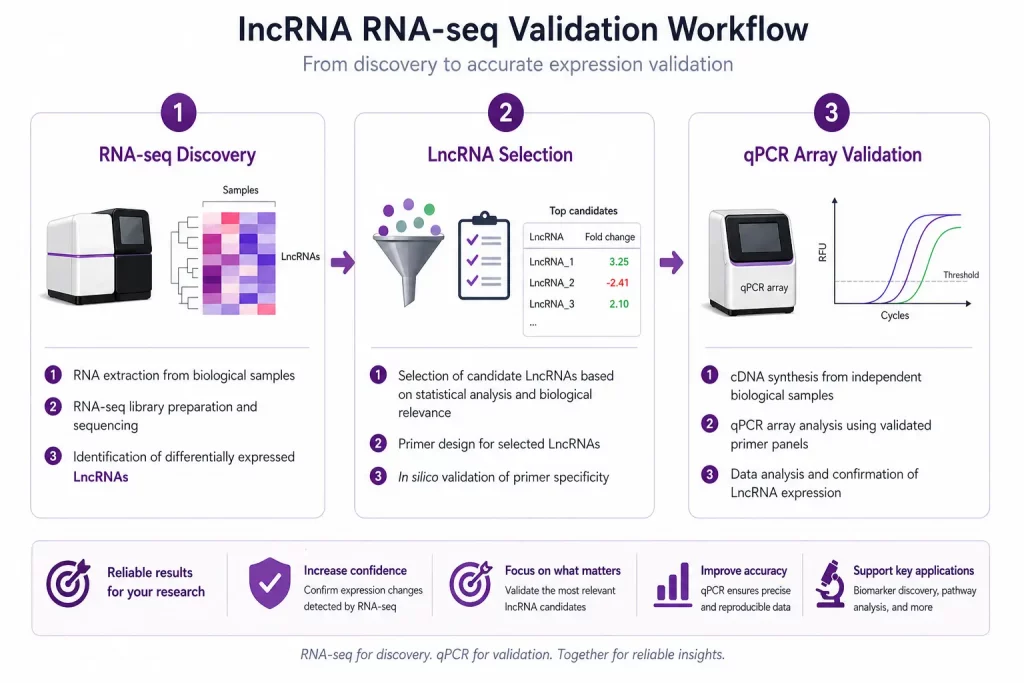
LncRNA RNA-seq validation is a critical step to confirm gene expression results and ensure reliable biological conclusions.
While RNA sequencing (RNA-seq) is widely used to identify differentially expressed long non-coding RNAs (lncRNAs), it does not always provide sufficient accuracy for low-abundance or structurally complex transcripts.
Validating lncRNA RNA-seq results using qPCR ensures reproducible and biologically relevant data, particularly in biomarker discovery and signaling pathway analysis.
In addition to qPCR assays, AnyGenes provides gene expression analysis, RNA-seq validation, and advanced biomarker discovery services based on proprietary high-throughput molecular platforms, supporting researchers worldwide.
Why lncRNA RNA-seq validation is required
RNA-seq is a powerful discovery tool, but several limitations affect lncRNA analysis:
Low read counts for weakly expressed lncRNAs
Transcript isoform ambiguity
Bias introduced during library preparation
False positives in differential expression analysis
These limitations make lncRNA RNA-seq validation essential to confirm expression changes.
RNA-seq results require validation due to variability and sensitivity limitations, particularly for low-expression transcripts, as demonstrated in benchmarking studies (Everaert et al., 2017).
Why qPCR is the gold standard for lncRNA RNA-seq validation
Quantitative PCR (qPCR) provides:
High sensitivity for low-abundance transcripts
High specificity with optimized assays
Accurate quantification of fold changes
Unlike RNA-seq, qPCR allows targeted validation, making it the preferred method for lncRNA RNA-seq validation.
AnyGenes provides validated lncRNA qPCR assays designed for high specificity and reliable detection of low-expression transcripts, based on proprietary assay design and extensive experience in complex RNA analysis.
These solutions enable reproducible and accurate validation across a wide range of experimental conditions.
Use cases of lncRNA RNA-seq validation
Cancer biomarker confirmation
Immune pathway analysis
Cardiovascular research
Neuroscience studies
Common mistakes in lncRNA RNA-seq validation
Using non-validated primers
Ignoring isoform specificity
Poor normalization strategy
Insufficient replicates
Expert insight
RNA-seq is highly effective for discovery, but lncRNA RNA-seq validation requires a sensitive and targeted approach.
For complex transcripts, validated qPCR assays are essential to ensure specificity and reproducibility.
Key takeaways
lncRNA RNA-seq validation is essential for reliable results
RNA-seq alone may produce false positives
qPCR provides sensitive and specific validation
validated assays improve reproducibility
Frequently asked questions
Why is lncRNA RNA-seq validation necessary?
Because RNA-seq may generate false positives and lacks sensitivity for low-expression transcripts.
How many lncRNAs should be validated?
A subset is selected based on statistical significance and biological relevance.
Can standard primers be used for lncRNA validation?
Yes, but validated assays are recommended to ensure specificity and reproducibility.
What is the main challenge in lncRNA RNA-seq validation?
Low expression levels and transcript complexity..
Why is qPCR preferred for RNA-seq validation?
qPCR is preferred for RNA-seq validation because it provides high sensitivity, specificity, and accurate quantification of gene expression changes, especially for low-abundance transcripts.
Need support for your lncRNA RNA-seq validation project?
Whether you are confirming RNA-seq results or identifying biomarkers, AnyGenes provides validated solutions and expert support tailored to your research.