TGF beta Signaling Pathway – Cancer, Fibrosis and Biomarker Analysis
What is the TGF beta signaling pathway
The TGF beta signaling pathway (Transforming Growth Factor beta signaling pathway) is a fundamental regulator of cell growth, differentiation, immune homeostasis, and tissue remodeling. It plays a dual role in physiology and disease by tightly controlling cellular plasticity, inflammation, and extracellular matrix production.
TGF-β signaling is activated in response to developmental cues, tissue injury, and immune challenges. Depending on cellular context, it can suppress cell proliferation and inflammation or promote fibrosis, immune evasion, and tumor progression.
Dysregulation of the TGF beta signaling pathway is a hallmark of cancer progression, fibrotic disorders, and immune-mediated diseases, making it a major focus of translational research and therapeutic development.
TGF beta signaling pathway activity can be efficiently assessed by measuring gene expression of core regulators, downstream targets, and pathway-specific biomarker signatures.
Central regulator of cell fate, differentiation, and tissue remodeling
Operates through canonical SMAD and non-canonical signaling branches
Critical driver of fibrosis, EMT, and tumor progression
Major immunomodulatory pathway in cancer and autoimmunity
Highly suitable for biomarker discovery and gene expression profiling
Core components of the TGF beta signaling pathway
TGF-β ligands
The TGF-β superfamily includes TGF-β1, TGF-β2, and TGF-β3, as well as activins and bone morphogenetic proteins (BMPs), which regulate development and tissue homeostasis.
TGF-β receptors
TGF-β signals through type I (TGFBR1) and type II (TGFBR2) serine/threonine kinase receptors. Ligand binding triggers receptor complex formation and downstream signaling activation.
SMAD transcription factors
Canonical signaling is mediated by SMAD2 and SMAD3, which associate with SMAD4 and translocate to the nucleus to regulate gene expression.
Regulatory proteins
Inhibitory SMADs (SMAD6, SMAD7) and co-factors fine-tune pathway intensity and duration, preventing excessive signaling.
Mechanisms of TGF beta signaling
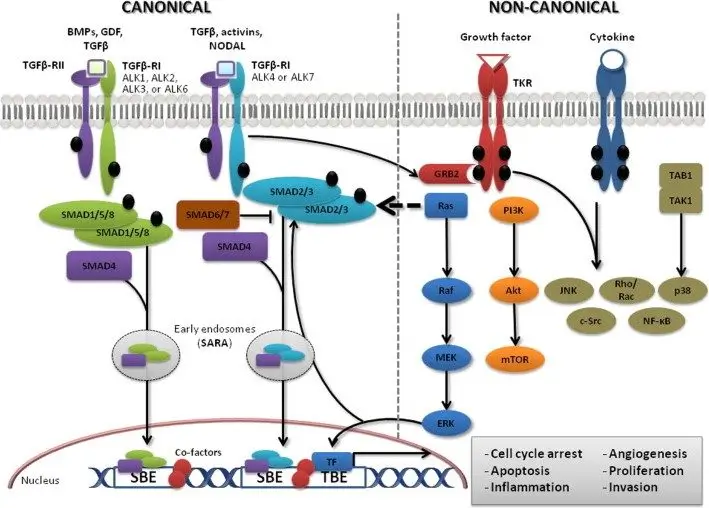
TGF-β signaling operates through two major branches:
Canonical (SMAD-dependent) signaling
Activation of SMAD2/3 phosphorylation
Formation of SMAD2/3-SMAD4 complexes
Nuclear translocation and transcriptional regulation of target genes
It is a multifunctional signaling pathway that regulates cell growth, differentiation, immune responses, and tissue remodeling through TGF-β receptor activation.
What is the role of TGF-β in cancer?
TGF-β suppresses early tumor growth but later promotes invasion, metastasis, immune evasion, and therapy resistance.
How is TGF beta signaling involved in fibrosis?
Persistent TGF-β activation stimulates extracellular matrix production, leading to tissue scarring and organ dysfunction.
How can TGF beta signaling activity be analyzed?
By measuring expression of pathway regulators and downstream targets using targeted gene expression approaches such as qPCR pathway arrays.
TGF beta signaling pathway biomarker list
You can check the biomarker list included in this pathway, see below:
Looking for more answers? Visit our Help & FAQ section to find detailed informations about our products, services, and technical support.
Bibliography
1. Suriyamurthy S et al. Epigenetic Reprogramming of TGF-β Signaling in Breast Cancer. Cancers (Basel). (2019) 24;11(5).
2. Chen J et al. Immunomodulatory TGF-β Signaling in Hepatocellular Carcinoma. Trends Mol Med. (2019).
3. Chen Y et al. Transforming growth factor β signaling pathway: A promising therapeutic target for cancer. J Cell Physiol. (2019).
4. Batlle E et Massagué J. Transforming Growth Factor-β Signaling in Immunity and Cancer. Immunity. (2019) 16;50(4):924-940.
5. Pellatt AJ et al.The TGFβ-signaling pathway and colorectal cancer: associations between dysregulated genes and miRNAs. J Transl Med. (2018);16(1):191.
6. Papoutsoglou P et al. Transforming Growth Factor-Beta (TGFβ) Signaling Pathway in Cholangiocarcinoma. Cells. (2019)23;8(9).
7. Neuzillet C et al. Targeting the TGFβ pathway for cancer therapy. PharmacolTher. (2015);147:22-31.
8. Bellomo C et al. Transforming growth factor β as regulator of cancer stemness and metastasis. Br J Cancer. 2016 Sep 27;115(7):761-9.
Need pricing information or distributor details?
For quotations, product information, or project discussions, please contact our team at
[email protected].