Hi, Continue visiting your profile
user

Login

Email

Password

Create account
Forget password
AnyGenes
  • email login

NF-κB Signaling Pathway – Functions, Disease Implications and Biomarker Analysis

What is the NF-κB signaling pathway?

The NF-κB  signaling pathway (nuclear factor kappa-light-chain-enhancer of activated B cells pathway)  is a central regulatory pathway controlling immune response, inflammation, cell survival, and stress adaptation.

NF-κB signaling is activated by a wide range of stimuli, including pro-inflammatory cytokines, microbial infections, oxidative stress, and cellular damage. Once activated, NF-κB transcription factors translocate to the nucleus and regulate the expression of genes involved in immune defense, inflammation, apoptosis, and cell proliferation.

Dysregulation of NF-κB signaling is strongly associated with chronic inflammatory diseases, cancer, cardiovascular disorders, and neurodegenerative conditions, making it one of the most intensively studied signaling pathways in biomedical research.

AnyGenes NFKB pathway qPCR array for inflammation and immunity research.

NF-κB pathway activity can be efficiently assessed through targeted gene expression analysis of pathway regulators and downstream transcriptional targets.

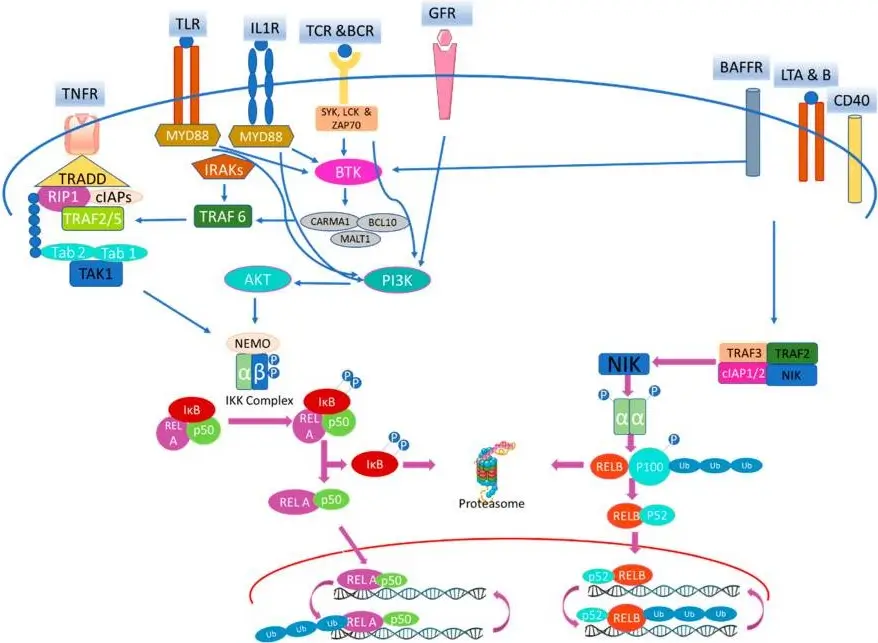
canonical and non-canonical Nuclear factor kappa B (NF-κB) signaling pathways.
Schematic diagram of the canonical and non-canonical Nuclear factor kappa B (NF-κB) signaling pathways.

Key takeaways

  • Master regulator of inflammation and immune responses
  • Rapid signal transmission from cytoplasm to nucleus
  • Operates through canonical and non-canonical pathways
  • Strongly implicated in cancer and chronic inflammatory diseases
  • Highly suitable for biomarker discovery and gene expression profiling

Core components of the NF-κB pathway

NF-κB transcription factor dimers

NF-κB exists as homo- or heterodimers composed of RelA (p65), RelB, c-Rel, p50, and p52 subunits.

IκB inhibitory proteins

IκB proteins sequester NF-κB dimers in the cytoplasm and prevent nuclear translocation under resting conditions.

IKK complex

The IκB kinase (IKK) complex, composed of IKKα, IKKβ, and IKKγ/NEMO, phosphorylates IκB proteins, targeting them for proteasomal degradation.

Upon IκB degradation, NF-κB dimers translocate to the nucleus and activate gene transcription.

Canonical and non-canonical NF-κB activation pathways

Canonical pathway

  • Triggered by TNF-α, IL-1, microbial products, and stress signals
  • Involves IKKβ-mediated IκB degradation
  • Activates RelA/p50 dimers
  • Regulates acute inflammation and innate immunity

Non-canonical pathway

  • Activated by specific stimuli such as BAFF, CD40, and lymphotoxin-β
  • Involves processing of p100 to p52
  • Activates RelB/p52 dimers
  • Controls lymphoid organogenesis and adaptive immune responses

Biological functions of NF-κB signaling

NF-κB signaling regulates essential cellular and physiological processes:
  • Inflammation: Induction of cytokines, chemokines, and inflammatory mediators.
  • Immune responses: Regulation of innate and adaptive immunity.
  • Cell survival and apoptosis: Induction of anti-apoptotic gene programs.
  • Stress and damage responses: Adaptation to oxidative stress and cellular injury.

Pathway cross-talk and signal integration

NF-κB signaling interacts extensively with other signaling networks:

This cross-talk adds regulatory complexity and expands the range of NF-κB-dependent biological outcomes.

Therapeutic targeting of NF-κB signaling

Given its central role in disease, NF-κB is a major therapeutic target:

  • Small-molecule NF-κB and IKK inhibitors in clinical development
  • Anti-inflammatory strategies targeting upstream activators
  • Combination therapies in oncology and chronic inflammatory diseases

NF-κB signaling dysregulation and disease

Chronic inflammatory diseases

Persistent NF-κB activation contributes to:

  • Rheumatoid arthritis
  • Inflammatory bowel disease
  • Asthma

Cancer

Constitutive NF-κB signaling promotes:

  • Tumor cell survival
  • Angiogenesis
  • Metastasis
  • Resistance to chemotherapy

Cardiovascular and neurodegenerative disorders

NF-κB dysregulation is implicated in:

  • Atherosclerosis and heart failure
  • Alzheimer’s and Parkinson’s diseases

Why study the NF-κB signaling pathway with AnyGenes?

At AnyGenes®, we provide high-performance qPCR arrays and customizable SignArrays® designed for NF-κB pathway analysis and biomarker discovery. Our solutions enable researchers to:
  • Quantify NF-κB-dependent gene expression signatures
  • Analyze upstream regulators and downstream transcriptional targets
  • Study pathway cross-talk with MAPK, PI3K-AKT, and JAK-STAT
  • Generate robust, reproducible, and publication-ready data

NF-κB signaling pathway biomarker analysis with AnyGenes®

What can be analyzed?

  • NF-κB subunits and regulatory components
  • Inflammatory cytokines and chemokines
  • Cell survival and apoptosis-related genes
  • Disease-associated NF-κB biomarkers

Available solutions

  • Pre-designed NF-κB Pathway qPCR Arrays
  • Fully customizable SignArrays®
  • Expert support for experimental design and data interpretation

Customize your own signaling pathways (SignArrays®) with the factors of your choice!
Simply download and complete our Personalized SignArrays® information file and send it at [email protected] to get started on your project.

Frequently asked questions

NF-κB signaling regulates inflammation, immune responses, cell survival, and stress adaptation by controlling the expression of numerous target genes.

NF-κB is activated by cytokines, microbial products, oxidative stress, and cellular damage signals.

NF-κB dysregulation is linked to chronic inflammatory diseases, cancer, cardiovascular disorders, and neurodegenerative diseases.

The canonical pathway mediates rapid inflammatory responses, while the non-canonical pathway regulates adaptive immunity and lymphoid development.

NF-κB activity can be analyzed by measuring the expression of pathway regulators and downstream target genes using targeted qPCR pathway arrays.

  1. Wang Y, et al. NF-κB signaling in skin aging. Mech Ageing Dev. (2019);184:111160.
  2. Soleimani A, et al. Role of the NF-κB signaling pathway in the pathogenesis of colorectal cancer. Gene. (2020);726:144132.
  3. Ramadass V, et al. Small Molecule NF-κB Pathway Inhibitors in Clinic. Int J Mol Sci. (2020);21(14):5164.
  4. Singh S, & Singh TG. Role of Nuclear Factor Kappa B (NF-κB) Signalling in Neurodegenerative Diseases: An Mechanistic Approach. Curr Neuropharmacol. (2020);18(10):918-935

NF-KB signaling pathway biomarker list

You can check the biomarker list included in this pathway, see below:

Looking for more answers? Visit our Help & FAQ section to find detailed informations about our products, services, and technical support.

For more information on prices, please contact us at: