MAPK Signaling Pathway: Regulation, Functions, Disease Implications and Biomarker Analysis
What is the MAPK signaling pathway?
The MAPK signaling pathway (Mitogen-Activated Protein Kinase pathway) is a fundamental signal transduction cascade that converts extracellular stimuli, such as growth factors, cytokines, stress signals, and environmental cues, into specific cellular responses, including cell proliferation, differentiation, inflammation, stress adaptation, and apoptosis.
MAPK signaling acts as a central regulatory hub in normal physiology and disease. Dysregulation of this pathway is strongly associated with cancer, immune disorders, cardiovascular diseases, and neurodegenerative conditions, making it one of the most intensively studied signaling pathways in biomedical research.
MAPK pathway activity can be efficiently assessed by measuring gene expression of key pathway regulators, downstream targets, and branch-specific gene signatures.
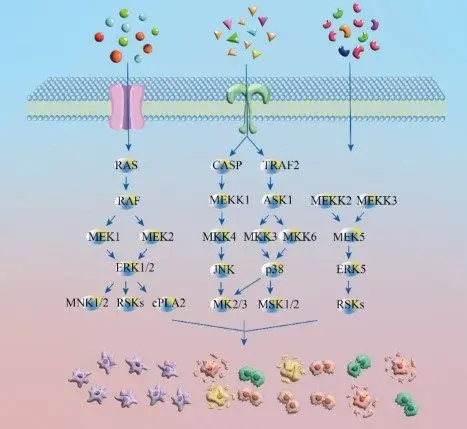
Three major transduction pathways of the MAPK-signaling pathway. When chemical molecules of natural products enter the cell membrane, they interact with key target proteins of the MAPK-signaling pathway. These in turn activate the cascade response of the MAPK-signaling pathway, thereby regulating apoptosis in cancer cells.
Key takeaways – MAPK signaling pathway
Core pathway translating extracellular signals into gene expression programs
Organized as a three-tier kinase cascade (MAPKKK → MAPKK → MAPK)
Three major branches: ERK, JNK, and p38
Central role in cancer, inflammation, stress responses, and apoptosis
Highly suitable for targeted gene expression and biomarker analysis
Structure of the MAPK signaling cascade
MAPK signaling pathways are composed of three sequentially activated kinase tiers, ensuring signal amplification, specificity, and tight regulation.
MAP Kinase Kinase Kinases (MAPKKKs)
The upstream tier includes kinases such as RAF, activated by:
Growth factor receptors
Small GTPases (e.g. RAS)
Stress and inflammatory signals
Activated MAPKKKs phosphorylate and activate MAPKKs.
MAP Kinase Kinases (MAPKKs)
This intermediate tier includes kinases such as MEK1/2, which:
Integrate signals from MAPKKKs
Phosphorylate and activate MAPKs on conserved motifs
Mitogen-Activated Protein Kinases (MAPKs)
The terminal tier executes cellular responses by phosphorylating cytoplasmic and nuclear substrates, including transcription factors.
The three major MAPK branches are:
ERK (Extracellular signal-Regulated Kinase)
JNK (c-Jun N-terminal Kinase)
p38 MAPK
Major MAPK signaling pathways
ERK pathway
Primarily activated by growth factors and mitogens
Promotes cell proliferation, differentiation, and survival
Frequently dysregulated in cancer via RAS–RAF–MEK–ERK activation
JNK pathway
Activated by cellular stress, inflammatory cytokines, and DNA damage
Regulates apoptosis, immune responses, and stress adaptation
Plays a dual role in tumor suppression and tumor progression
p38 MAPK pathway
Strongly induced by environmental stress and inflammation
Controls cytokine production, cell cycle arrest, and apoptosis
Implicated in inflammatory and autoimmune diseases
Biological functions of MAP Kinase pathway
MAPK pathways regulate a wide range of essential biological processes:
Cell proliferation and differentiation: Especially mediated by ERK signaling through transcriptional regulation.
Apoptosis and survival: Balanced regulation via JNK and p38 signaling.
Inflammation and immune responses: Controls cytokine expression and immune cell activation.
Stress responses: Enables adaptation to oxidative stress, UV radiation, and DNA damage.
Signal amplification and specificity: Scaffold proteins organize pathway components to maintain fidelity and limit cross-talk.
Regulation of signaling activity
MAPK signaling is tightly controlled through:
Reversible phosphorylation and dephosphorylation
MAPK phosphatases (MKPs) that terminate signaling
Scaffold proteins that spatially organize pathway components
This multilayer regulation ensures precise signal duration and intensity, which is critical for normal cellular function.
MAP Kinase signaling pathway dysregulation and disease
Cancer
Constitutive activation of MAPK signaling—often through mutations in RAS, BRAF, or MEK—drives uncontrolled cell proliferation, survival, and therapy resistance.
MAPK signaling is a major therapeutic target in melanoma, lung cancer, colorectal cancer, and othermalignancies.
Inflammatory and immune diseases
Aberrant JNK and p38 signaling contributes to:
Chronic inflammation
Autoimmune diseases
Dysregulated cytokine production
Cardiovascular and neurodegenerative diseases
MAPK pathway dysregulation is involved in:
Cardiac hypertrophy
Ischemic injury
Neuronal stress responses and degeneration
Why study the MAPK signaling pathway with AnyGenes?
At AnyGenes®, we provide high-performance qPCR arrays and customizable SignArrays® specifically designed for MAPK signaling pathway analysis and biomarker discovery.
Our solutions enable researchers to:
Quantify ERK-, JNK-, and p38-specific gene signatures
Analyze upstream regulators and downstream transcriptional targets
Investigate pathway cross-talk with PI3K/AKT, mTOR, and NF-κB
Generate robust, reproducible, and publication-ready gene expression data
MAPK signaling pathway biomarker analysis with AnyGenes®
What can be analyzed?
Core MAPK regulators and kinases
Downstream transcription factors
Stress- and inflammation-related genes
Disease-associated MAPK biomarkers
Available solutions
MAPK pathway–focused qPCR array solutions
Fully customizable SignArrays®
Expert guidance for experimental design and data interpretation
Through targeted qPCR arrays or customized SignArrays® optimized for MAPK pathway biomarker analysis.
Shi A, et al. Natural products targeting the MAPK-signaling pathway in cancer: overview. J Cancer Res Clin Oncol. (2024)9;150(1):6.
Bahar ME, Kim HJ, Kim DR. Targeting the RAS/RAF/MAPK pathway for cancer therapy: from mechanism to clinical studies. Signal Transduct Target Ther. (2023)18;8(1):455.
Yue J, López JM. Understanding MAPK Signaling Pathways in Apoptosis. Int J Mol Sci. (2020)28;21(7):2346.
MAP Kinase signaling pathway biomarker list
You can check the biomarker list included in this pathway, see below: