Hi, Continue visiting your profile
user

Login

Email

Password

Create account
Forget password
AnyGenes
  • email login

Interferon Signaling Pathway – Gene Expression and Biomarker Analysis

What is interferon signaling pathway and why is it important?

Interferon signaling pathway analysis focuses on the study of interferon-mediated immune responses and gene expression changes involved in antiviral defense and immune regulation.

Interferons (IFNs) are cytokines that play a central role in host defense against viral infections, cancer, and immune dysregulation. They act as key signaling molecules coordinating innate and adaptive immune responses.

Interferons are classified into three main types:

  • Type I interferons (IFN-α, IFN-β)
  • Type II interferon (IFN-γ)
  • Type III interferons (IFN-λ)

Each interferon type activates distinct yet interconnected signaling pathways regulating antiviral immunity, inflammation, and immune cell activation.

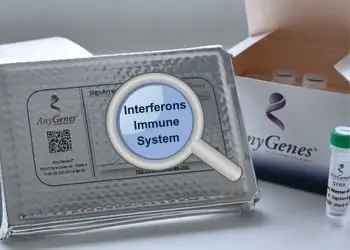
AnyGenes array showcasing interferons and their role in the immune system.

Interferon signaling pathway analysis is commonly performed using gene expression profiling and qPCR-based approaches

Interferon biomarker list
Selecting the right gene set is critical for accurate interferon pathway analysis. Explore the genes involved in interferon signaling, antiviral responses, and immune regulation.
View the full biomarker list
.

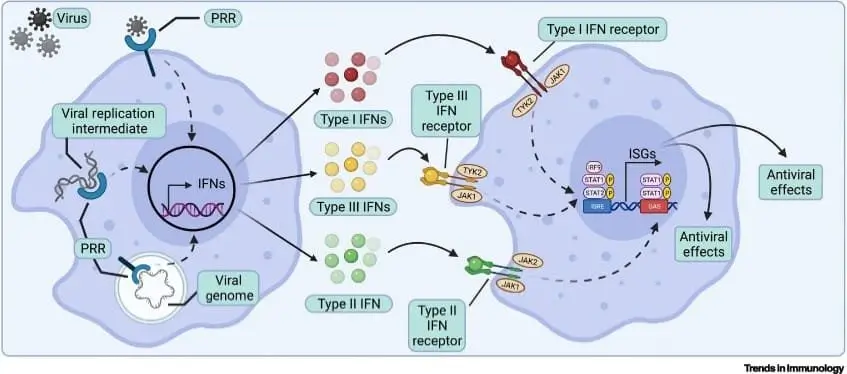
Overview of interferon signaling pathways in vertebrate hosts.
AMPK substrates act in specific subcellular locales to rewire metabolism.
Overview of interferon signaling pathways in vertebrate hosts. Production of interferons (IFNs) begins with the binding of viral molecules, such as genomic nucleic acids, to either cell surface or intracellular pattern recognition receptors (PRRs) [18,19]. The resulting signaling cascade activates transcription and secretion of IFNs, which then bind to their associated IFN receptor on the same and nearby cells. Binding of IFNs to their receptors activates a signal cascade by Janus tyrosine kinases (JAK) and tyrosine kinase (TYK) that leads to the phosphorylation of STAT1 and/or STAT2 [9,15]. For type I and III IFNs, STAT1 and STAT2 complex with IRF9 and bind to IFN-stimulated response elements (ISREs) to express IFN-stimulated genes (ISGs). For type II IFNs, phosphorylated STAT1 dimers bind to gamma-activated site (GAS) elements for ISG production [9,15]. In turn, ISGs mediate antiviral effects directly within infected cells, or further induce innate and adaptive immune responses [3,120].

Interferon signaling pathway: key takeaways

  • Central regulators of antiviral and antitumor immunity
  • Bridge innate and adaptive immune responses
  • Act through JAK-STAT signaling pathways
  • Control expression of interferon-stimulated genes (ISGs)

When to study interferon signaling pathway?

Interferon pathway analysis is widely used to investigate immune responses and disease mechanisms.

It is particularly relevant for:

  • viral infections (influenza, SARS-CoV-2)
  • cancer and immunotherapy
  • autoimmune diseases
  • inflammatory disorders
  • host-pathogen interactions

Types of interferons and their immune functions

Type I interferons (IFN-α / IFN-β)

Rapidly produced in response to viral infection, they induce strong antiviral responses through ISGs.

Type III interferons (IFN-λ)

Act mainly at epithelial barriers and provide localized antiviral protection.

Type II interferon (IFN-γ)

Produced by NK and T cells, it regulates immune activation, macrophage function, and antigen presentation.

Interferon signaling mechanisms

Interferon signaling is initiated when pathogen-associated molecules bind to pattern recognition receptors (PRRs).

This leads to:

  • activation of JAK and TYK2 kinases
  • phosphorylation of STAT1 and STAT2
  • formation of transcription complexes (STAT1-STAT2-IRF9)

Type II interferons activate STAT1 homodimers.

These complexes bind DNA regulatory elements (ISRE, GAS) to induce expression of interferon-stimulated genes (ISGs), which mediate antiviral and immune functions.

Key genes involved in interferon signaling pathway analysis

Interferons and ligands

IFNA1, IFNA2, IFNA4, IFNA5, IFNA6, IFNA8, IFNA14, IFNA21,IFNB1, IFNK, IFNW1, IFNG, IFNE

Receptors and signaling components

IFNAR1, IFNAR2, IFNGR1, IFNGR2, IL28RA, IL10RB

Interferon-stimulated genes (ISGs)

IFI44, IFI44L, IFI6, IFI27, IFI16, IFIT1, IFIT2, IFIT3, IFIT1B, IFITM1, IFITM2, ISG15, MX1, OAS1, ADAR

Transcription factors and regulators

IRF1, IRF2, IRF3, IRF4, IRF5, IRF6, IRF7, IRF8, IRF2BP1, IRF2BP2

Cytokine and receptor signaling network

IL6, IL15, IL12B, IL21R, IL2RB, IL2RG, IL4R, IL5RA, IL7R, IL9R, IL10RA, IL20RA, IL20RB, IL22RA2

Immune response and antiviral effectors

CXCL10, IFIH1, IRGM, PSME1, PYHIN1, IFI30

Additional immune and signaling genes

CRLF2, CSF2RA, CSF3R, EBI3, CNTFR, LEPR, MPL, SP110, F3, TTN

How to analyze interferon signaling pathway?

Analyzing interferon responses requires accurate measurement of gene expression across multiple pathways.

Gene expression profiling for interferon pathway analysis

Transcriptomic approaches provide a global overview of interferon-related gene expression and pathway activation.

qPCR-based interferon signaling pathway analysis

qPCR enables targeted, sensitive, and reproducible measurement of interferon-related genes.

This approach is particularly relevant for focused studies and limited sample availability.

Workflow:

  1. Select relevant interferon and ISG genes
  2. Measure gene expression using qPCR or transcriptomics
  3. Normalize data
  4. Compare experimental conditions

Key considerations:

  • targeted gene panels improve reproducibility
  • qPCR enables sensitive and robust analysis
  • customized panels allow pathway-focused investigation
  • targeted approaches are faster and more cost-effective

Applications of interferon signaling pathway analysis

Viral infections

Control of viral replication and immune defense.

Cancer

Regulation of tumor immunity and response to immunotherapy.

Autoimmune diseases

Chronic interferon activation contributes to disease progression.

Inflammation

Regulation of immune balance and tissue responses.

Why study interferons immune system with AnyGenes®?

Understanding interferon responses requires precise gene expression analysis tools.

AnyGenes® provides customized qPCR panels designed for interferon pathway analysis and immune profiling.

Key advantages:

  • flexible gene panel design
  • pathway-focused selection
  • high reproducibility
  • standardized workflows

Analyze your pathway data with AnyGenes® software

Scientific data is only as powerful as the analysis behind it.

AnyGenes® provides a dedicated data analysis tool specifically developed for SignArrays® pathway panels.

What does it allow you to do?

  • Automated ΔCq calculation
  • Normalization with selected housekeeping genes
  • Comparison of up to 10 experimental conditions
  • Generation of descriptive statistics
  • Publication-ready graphs
  • Exportable tables for manuscripts and presentations

Developed on Excel (compatible with 2007+), the software is user-friendly and requires no advanced bioinformatics skills.

Customize your own signaling pathways (SignArrays®) with the factors of your choice!
Simply download and complete our Personalized SignArrays® information file and send it at [email protected] to initiate your project.

Frequently asked questions

What are interferons in the immune system?

Interferons are cytokines that coordinate antiviral defense, immune activation, and regulation of inflammation.

What is the role of interferon-stimulated genes (ISGs)?

ISGs execute antiviral, immunomodulatory, and inflammatory functions downstream of interferon signaling.

How are interferons linked to JAK-STAT signaling?

Interferons activate JAK-STAT pathways to regulate immune gene expression.

How can interferon responses be analyzed experimentally?

By measuring expression of interferons, receptors, and ISGs using targeted gene expression approaches such as qPCR arrays.

Interferons immune system biomarker list

You can check the biomarker list included in this pathway, see below:

Looking for more answers? Visit our Help & FAQ section to find detailed information about our products, services, and technical support.

Bibliography

1. He Y, et al. Suppression of Interferon Response and Antiviral Strategies of Bunyaviruses. Trop Med Infect Dis. (2024)7;9(9):205.

2. Liu YG, et al. Interferon lambda in respiratory viral infection: immunomodulatory functions and antiviral effects in epithelium. Front Immunol. (2024)1:15:1338096.

3. Schoggins JW. Interferon-Stimulated Genes: What Do They All Do? Annu Rev Virol. (2019)29;6(1):567-584.

4. Lee AJ, Ashkar AA. The Dual Nature of Type I and Type II Interferons. Front Immunol. (2018)11;9:2061.

5. MacMicking JD. Interferon-inducible effector mechanisms in cell-autonomous immunity. Nat Rev Immunol. (2012)25;12(5):367-82.

Need pricing information or distributor details?
For quotations, product information, or project discussions, please contact our team at [email protected].