Hi, Continue visiting your profile
user

Login

Email

Password

Create account
Forget password
AnyGenes
  • email login

Immune Tolerance Analysis – Gene Expression and Immune Regulation

What is immune tolerance and why is it important?

Immune tolerance analysis focuses on understanding how the immune system maintains a delicate balance between activation and suppression. The immune system must react efficiently against pathogens while avoiding damage to the body’s own tissues, making tolerance mechanisms essential for immune homeostasis.

Immune tolerance is not a passive process, it is actively regulated through complex cellular and molecular pathways involving T cell activation, differentiation, and suppression.

AnyGenes array for immune tolerance research, supporting the study of immune response and regulation.

In practice, immune tolerance analysis is commonly performed using gene expression profiling and qPCR-based approaches to characterize tolerance pathways and regulatory mechanisms.

Immune tolerance biomarker list
View the genes included in our Immune tolerance -related qPCR arrays.
Understanding immune tolerance requires analyzing a network of genes controlling immune activation and suppression. These gene sets provide a strong foundation for designing customized qPCR panels for targeted immune tolerance analysis.

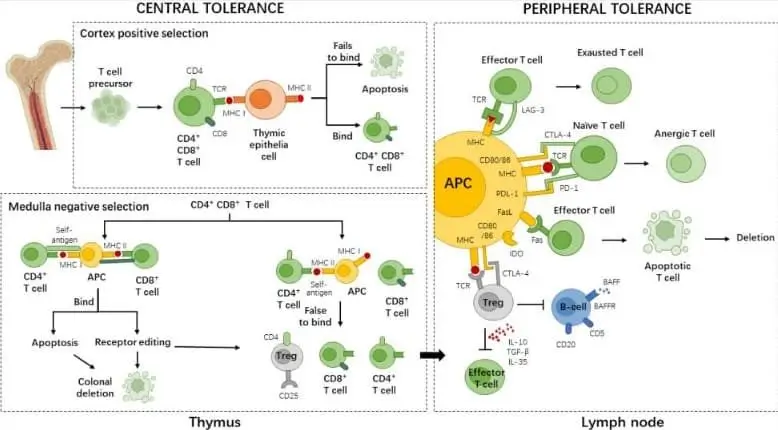
The mechanism of T cell tolerance.
AMPK substrates act in specific subcellular locales to rewire metabolism.
The mechanism of T cell tolerance. Central tolerance of T cells occurs in the thymus. Hematopoietic lymphoid progenitors migrate to cortex, where they are screened by thymic epithelia cells and develop into CD4+CD8+ double-positive (DP) thymocytes expressing the T-cell antigen receptor (TCR). DP cells migrate to the medulla. After screening for the ability to bind to self-peptide-associated major histocompatibility complex class I (MHC-I) or MHC class II (MHC-II) molecules on the antigen-presenting cell (APC) surface, DP cells develop into CD4+CD8+ DP thymocytes expressing the TCR. Screening for binding capacity of molecules culminating in Treg CD8+ T cells, and CD4+ T cells migrate to lymph node to undergo peripheral tolerance.
Peripheral tolerance mechanisms, such as exhaustion, deletion, anergy, and regulation are mainly relied upon to suppress the activity of self-reactive T cells. Exhaustion and deletion are realized through inhibiting cell function or proliferative capacity of effector T cell and apoptosis. Anergy describes a state of hyporesponsiveness of naive T cells to TCR stimuli after exposure to antigen. Treg cells regulate by inhibiting effector T cell activity and B cell proliferation via interleukin-(IL)-10, Transforming growth factor-β (TGF-beta), and IL-35.

Key Takeaways

  • Maintains immune balance between activation and suppression
  • Essential to prevent autoimmune diseases
  • Strongly regulated by T cell signaling and regulatory T cells (Tregs)
  • Involves complex and interconnected signaling pathways
  • Highly relevant for biomarker discovery and immunotherapy

When to perform immune tolerance analysis?

Studying immune tolerance is essential when trying to understand why the immune system fails to maintain balance.

It is particularly relevant to:

  • investigate autoimmune diseases
  • study regulatory T cell (Treg) activity
  • analyze immune suppression in cancer
  • evaluate chronic inflammatory conditions
  • support immunotherapy development

Key genes involved in immune tolerance

Immune tolerance relies on a tightly regulated network of genes controlling T cell activation, immune suppression, and maintenance of immune homeostasis.

This section highlights representative genes involved in immune tolerance. The complete biomarker panel includes a broader set of genes covering additional regulatory and signaling mechanisms.

CTLA4, PDCD1, BTLA, FOXP3, CD28, ICOS, CD40…

These genes are commonly used to assess immune tolerance mechanisms, regulatory T cell activity, and immune suppression pathways.

Explore the complete gene panel used for immune tolerance pathway analysis.

Download the complete biomarker list.

Mechanisms of immune tolerance

Immune tolerance is maintained through multiple complementary mechanisms that act at different stages of immune cell development and activation.

Central tolerance

Central tolerance occurs during immune cell development, primarily in the thymus, where strongly autoreactive T cells are eliminated.

Peripheral tolerance

Peripheral tolerance controls mature immune cells and prevents inappropriate activation.

This includes:

  • functional inactivation (anergy)
  • programmed cell death (apoptosis)
  • active suppression by regulatory T cells

Regulatory T cells (Tregs), particularly FOXP3+ cells, play a central role by producing immunosuppressive cytokines such as IL-10 and TGF-β.

How to analyze immune tolerance?

Analyzing immune tolerance is inherently complex because it involves multiple overlapping pathways and cell populations.

Distinguishing between immune activation and suppression states requires a targeted and precise approach.

Workflow:

  1. Select relevant tolerance-related and immune regulation genes
  2. Measure gene expression using qPCR or transcriptomic approaches
  3. Normalize and validate data
  4. Compare expression across biological conditions

Targeted gene panels are essential to focus on key biomarkers and reduce experimental variability.

qPCR-based approaches enable robust, reproducible, and sensitive immune tolerance analysis.

Customized qPCR panels allow precise investigation of Treg activity and immune suppression pathways.

Compared to transcriptomic approaches, targeted qPCR provides faster, cost-effective, and more reproducible analysis for focused studies.

Immune tolerance and disease relevance

Autoimmune diseases

Breakdown of immune tolerance leads to uncontrolled immune responses against self-antigens.

Cancer

Tumors exploit tolerance mechanisms to suppress immune responses and escape immune surveillance.

Chronic inflammation

Imbalance between activation and tolerance contributes to persistent inflammatory conditions.

Therapeutic approaches targeting immune tolerance

  • regulatory T cell-based therapies
  • tolerogenic vaccines
  • cytokine modulation (IL-2, TGF-β)
  • immune pathway targeting

Why study immune tolerance with AnyGenes®?

Understanding immune tolerance requires precise and reliable gene expression tools capable of capturing complex regulatory mechanisms.

AnyGenes® supports researchers with customized qPCR panels designed for immune tolerance analysis and pathway-focused gene expression studies.

Key advantages:

  • flexible gene panel design
  • targeted pathway analysis
  • high reproducibility
  • standardized workflows

These solutions are widely used in immunology and translational research.

Analyze your pathway data with AnyGenes® software

Scientific data is only as powerful as the analysis behind it.

AnyGenes® provides a dedicated data analysis tool specifically developed for SignArrays® pathway panels.

What does it allow you to do?

  • Automated ΔCq calculation
  • Normalization with selected housekeeping genes
  • Comparison of up to 10 experimental conditions
  • Generation of descriptive statistics
  • Publication-ready graphs
  • Exportable tables for manuscripts and presentations

Developed on Excel (compatible with 2007+), the software is user-friendly and requires no advanced bioinformatics skills.

Customize your own signaling pathways (SignArrays®) with the factors of your choice!
Simply download and complete our Personalized SignArrays® information file and send it at [email protected] to initiate your project.

Immune tolerance biomarker list

You can check the biomarker list included in this pathway, see below:

Looking for more answers? Visit our Help & FAQ section to find detailed information about our products, services, and technical support.

Bibliography

1. Kenison JE, et al. Therapeutic induction of antigen-specific immune tolerance. Nat Rev Immunol. (2024);24(5):338-357.

2. eng X, et al. Immunological mechanisms of tolerance: Central, peripheral and the role of T and B cells. Asia Pac Allergy. (2023)8;13(4):175–186..

3. Cifuentes-Rius A, et al . Inducing immune tolerance with dendritic cell-targeting nanomedicines. Nat Nanotechnol. (2021);16(1):37-46.

4. Moorman CD, et al . Emerging Therapeutics for Immune Tolerance: Tolerogenic Vaccines, T cell Therapy, and IL-2 Therapy. Front Immunol. (2021)29:12:657768.

Need pricing information or distributor details?
For quotations, product information, or project discussions, please contact our team at [email protected].