Human Leukocyte Antigen Analysis – Gene Expression and HLA Biomarkers
What is human leukocyte antigen and why is it important?
Human leukocyte antigen analysis focuses on the study of HLA molecules, a group of proteins encoded by the major histocompatibility complex (MHC) located on chromosome 6.
HLA molecules play a central role in the immune system by presenting peptide fragments to T cells, enabling the recognition of pathogens and abnormal cells. This mechanism is essential for adaptive immunity, immune surveillance, and self/non-self discrimination.
HLA variability is a key determinant of immune responses, influencing susceptibility to diseases, transplant compatibility, and responses to immunotherapies.
Human leukocyte antigen analysis relies on gene expression-based approaches to study antigen presentation and immune activation pathways.
Human leukocyte antigen biomarker list Explore the key genes involved in HLA-mediated antigen presentation and immune regulation.
View the full biomarker list.
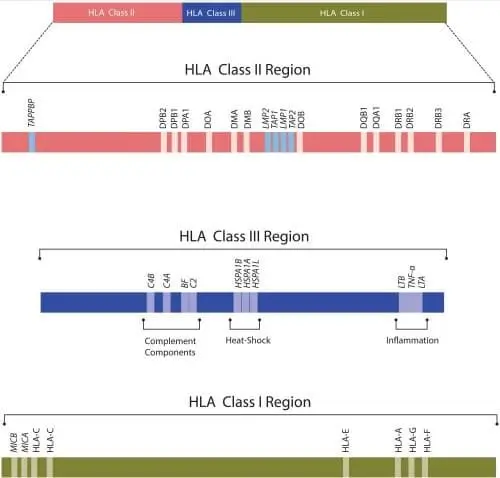
Map of the human HLA
The complex is conventionally divided into three regions: I, II, and III. Each region contains numerous loci (genes), only some of which are shown. Abbreviations: tapasin (TAPBP); large multifunctional proteases 1 and 2 (LMP1 and LMP2 respectively); transporter associated with antigen processing 1 and 2 (TAP1 and TAP2 respectively); complement components 2, 4A and 4B (C2, C4A and C4B respectively); complement factor B (BF); heat-shock protein 1A A-type, heat-shock protein 1A B-type, and heat-shock protein 1A–like (HSPA1A, HSPA1B and HSPA1L respectively); lymphotoxins A and B (LTA and LTB respectively); tumor necrosis factor α (TNF-α); major histocompatibility complex class I chain genes A and B (MICA and MICB respectively) (graphic from Castiblanco J, Anaya JM. 2015).
Human leukocyte antigen analysis: key takeaways
Central role in antigen presentation and immune recognition
Essential for transplantation compatibility
Highly polymorphic system influencing disease susceptibility
Strongly connected to immune regulation pathways
Suitable for gene expression-based biomarker analysis
When to perform human leukocyte antigen analysis?
Human leukocyte antigen analysis is essential in multiple research and clinical contexts.
It is commonly used to:
evaluate antigen presentation mechanisms
study immune responses in infection and inflammation
assess donor-recipient compatibility
identify biomarkers in cancer immunotherapy
investigate autoimmune diseases
HLA classes and biological function
Class I HLA molecules
(HLA-A, HLA-B, HLA-C) Present endogenous antigens to CD8+ T cells and enable elimination of infected or tumor cells.
Class II HLA molecules
(HLA-DP, HLA-DQ, HLA-DR) Expressed on antigen-presenting cells, they present exogenous antigens to CD4+ T cells and regulate immune responses.
Key genes involved in dendritic cell profiling
The HLA region is functionally connected to broader immune regulation pathways, including cytokine signaling and immune checkpoint mechanisms.
Analyzing HLA pathways can be challenging due to the high polymorphism and complexity of the MHC region.
Gene expression profiling for HLA analysis
Human leukocyte antigen analysis is commonly performed using gene expression profiling approaches to evaluate antigen presentation and immune activation.
Transcriptomic methods provide a global overview of gene expression patterns across HLA-related pathways.
qPCR-based human leukocyte antigen analysis
qPCR-based approaches provide targeted and highly reproducible measurement of HLA-related genes, enabling precise analysis of antigen presentation pathways.
This approach is particularly relevant for focused studies and limited sample availability.
Workflow:
Select relevant HLA and immune-related genes
Measure gene expression using qPCR or transcriptomic methods
Normalize data
Compare expression profiles
Key considerations:
Selecting targeted gene panels is essential to focus on relevant biomarkers and reduce variability
Targeted qPCR approaches enable robust, reproducible, and sensitive HLA analysis
Customized qPCR panels allow precise investigation of antigen presentation and immune regulation pathways
Compared to transcriptomic approaches, targeted qPCR provides faster, cost-effective, and reproducible results
Human leukocyte antigen analysis in disease and research
Transplantation
HLA matching is critical to reduce rejection risk and improve graft survival.
Autoimmune diseases
Specific HLA alleles are associated with diseases such as rheumatoid arthritis and type 1 diabetes.
Infectious diseases
HLA variability influences susceptibility to infections such as HIV and tuberculosis.
Cancer immunotherapy
HLA molecules regulate antigen presentation and influence responses to immunotherapies.
Therapeutic applications of human leukocyte antigen analysis
Looking for more answers? Visit our Help & FAQ section to find detailed information about our products, services, and technical support.
Bibliography
1. Medhasi S, Chantratita N. Human Leukocyte Antigen (HLA) System: Genetics and Association with Bacterial and Viral Infections. J Immunol Res. (2022)26;2022:9710376..
2. Wang C, et al. Human leukocyte antigen (HLA) and cancer immunotherapy: HLA-dependent and -independent adoptive immunotherapies. (2020).
3. Crux NB, Elahi S. Human Leukocyte Antigen (HLA) and Immune Regulation: How Do Classical and Non-Classical HLA Alleles Modulate Immune Response to Human Immunodeficiency Virus and Hepatitis C Virus Infections? Front Immunol. (2017)18:8:832.
4. Zhang GL, et al. Human Leukocyte Antigen Typing Using a Knowledge Base Coupled with a High-Throughput Oligonucleotide Probe Array Analysis. Front Immunol. (2014)27;5:597.
5. Cruz-Tapias P, et al. Chapter 10: Major histocompatibility complex: Antigen processing and presentation.
6. Castiblanco J, Anaya JM. Genetics and Vaccines in the Era of Personalized Medicine.Curr Genomics. (2015)16(1):47–59.
Need pricing information or distributor details?
For quotations, product information, or project discussions, please contact our team at
[email protected].