Cell Surface Marker Analysis – Biomarkers and Gene Expression
What are cell surface markers?
Cell surface markeranalysis focuses on the characterization of proteins, glycoproteins, or carbohydrates expressed on the plasma membrane that enable cell identification, communication, and interaction with the extracellular environment
These markers define cellular identity across diverse biological contexts, including immune cell subsets, stem cell populations, and tumor cells. Their expression patterns are widely used to classify cell types, monitor differentiation states, and characterize disease-associated phenotypes.
Beyond phenotyping, surface markers also participate in signal transduction processes that regulate immune activation, proliferation, and cell fate decisions, making them central to both basic research and translational applications.
Cell surface marker profiles can be efficiently assessed by measuring gene expression of lineage-associated markers, activation-related molecules, adhesion proteins, and cell-type-specific transcriptional signatures. Such expression profiling supports precise characterization of cellular identity, functional states, and phenotypic heterogeneity across immune, stromal, and tumor-associated cell populations..
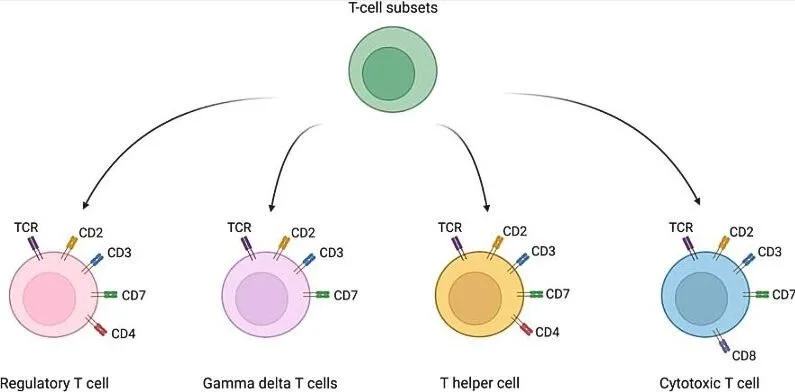
Differentiation of T-cell subsets and their respective cell surface marker (graphic from Gosmann D, et al. 2022).
Key Takeaways
Essential tools for cell identification and classification
Widely used in immunology, oncology, and stem cell research
Involved in signaling pathways regulating cell behavior
Strong relevance as biomarkers in disease and therapy
Suitable for gene expression-based profiling approaches
Key cell surface markers and applications
Immune cell markers:
T cell: CD3D, CD4, CD8A B cell: CD19, CD79A, MS4A1
Innate and myeloid markers: CD163, CSF1R, FCGR1A
Endothelial and adhesion markers: PECAM1, VCAM1, ICAM2
Cancer-associated markers: EPCAM, KRT8, KRT18
Stem cell and stromal markers: NT5E (CD73), ENG
These marker categories collectively reflect immune cell identity, activation states, tissue-specific phenotypes, and tumor-associated profiles.
Molecular and functional roles of cell surface markers
Cell surface markers are not limited to passive identification. Many act as receptors or co-receptors that actively regulate intracellular signaling pathways.
Markers such as CD4 and CD8 participate in T cell receptor (TCR) signaling, modulating immune activation. Others, including EGFR and PD-1/PD-L1, influence tumor progression, immune evasion, and therapeutic response.
These molecules often function at the interface between extracellular signals and intracellular pathways, integrating environmental cues into coordinated cellular responses.
Related signaling pathways
T cell receptor (TCR) signaling
NF-κB signaling pathway
JAK-STAT signaling pathway
EGFR signaling pathway
Adhesion and integrin signaling pathways
Cell surface marker analysis: biomarkers and gene expression signatures
Gene expression analysis provides a robust and scalable approach to study cell surface markers beyond protein-level detection, enabling high-throughput and quantitative profiling across complex biological samples.
The panel integrates immune cell markers, antigen presentation molecules, adhesion proteins, and tumor-associated markers, providing a comprehensive view of cell identity and functional states.
This transcriptional approach complements protein-level analyses such as flow cytometry, enabling scalable and multiplexed investigation of cell surface marker expression.
Looking for more answers? Visit our Help & FAQ section to find detailed informations about our products, services, and technical support.
Bibliography
1. Fonseca LN, et al. Cell surface markers for mesenchymal stem cells related to the skeletal system: A scoping review. Heliyon. (2023)10;9(2):e13464.
2. Gosmann D, et al. Promise and challenges of clinical non-invasive T-cell tracking in the era of cancer immunotherapy. EJNMMI Res. (2022)31;12:5.
3. Meyfour A, et al. The quest of cell surface markers for stem cell therapy. Cell Mol Life Sci. (2021) ;78(2):469-495.
Need pricing information or distributor details?
For quotations, product information, or project discussions, please contact our team at
[email protected].