Apoptosis signaling pathway: key mechanisms in cell death and survival
What is the apoptosis signaling pathway?
The apoptosis signaling pathway is a tightly regulated biological process responsible for programmed cell death, essential for maintaining tissue homeostasis, immune balance, and normal development. Unlike necrosis, apoptosis eliminates damaged, infected, or unnecessary cells in a controlled, non-inflammatory manner.
Apoptosis is activated in response to intrinsic stress signals or extrinsic death signals and determines whether a cell survives or undergoes irreversible death.
Dysregulation of apoptosis contributes to a wide range of diseases, including cancer, autoimmune disorders, neurodegenerative diseases, and chronic inflammatory conditions.
Apoptosis pathway activity can be efficiently assessed by measuring gene expression of core regulators, downstream effectors, and pathway-specific biomarker signatures.
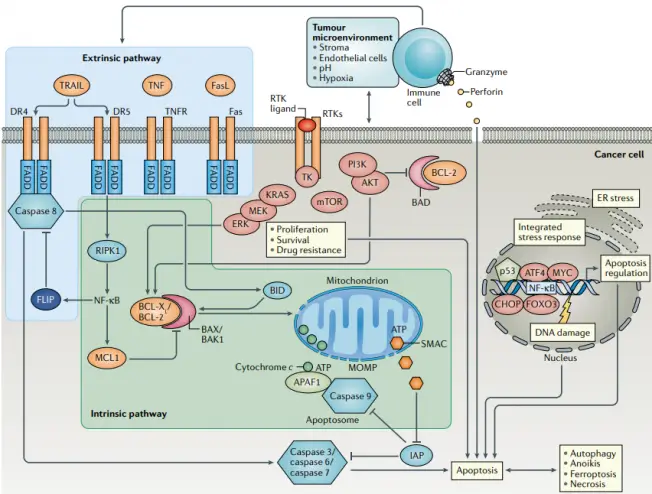
Overview of apoptosis signalling pathways and the effects of pro-survival signalling, immune cells and the tumour microenvironment
Key takeaways
Central mechanism controlling programmed cell death
Balances cell survival and elimination
Operates through intrinsic, extrinsic, and immune-mediated pathways
Strongly linked to cancer, immune diseases, and neurodegeneration
Highly suitable for biomarker discovery and gene expression profiling
Major apoptosis signaling pathways
Extrinsic pathway (death receptor)
The extrinsic pathway is initiated by extracellular ligands binding to death receptors on the cell surface. These receptors belong to the TNF receptor superfamily and include TNFR1, Fas (CD95), and TRAIL receptors.
Ligand binding triggers the formation of the Death-Inducing Signaling Complex (DISC), leading to activation of caspase-8 and downstream effector caspases that execute apoptosis.
Intrinsic pathway (mitochondrial)
The intrinsic pathway responds to internal cellular stress such as DNA damage, oxidative stress, oncogene activation, or cytotoxic drugs.
Key events include:
Mitochondrial outer membrane permeabilization
Release of cytochrome c into the cytosol
Formation of the apoptosome (Apaf-1, procaspase-9)
Activation of caspase-9, followed by effector caspases
This pathway is tightly regulated by the BCL-2 family of proteins, which control mitochondrial integrity.
Perforin / Granzyme pathway
This pathway is used by cytotoxic T lymphocytes and NK cells to eliminate infected or malignant cells.
Perforin forms pores in the target cell membrane, allowing granzyme B to enter and directly activate caspases or trigger mitochondrial apoptosis.
Molecular regulation of apoptosis
Crosstalk between pathways
Apoptosis pathways are interconnected. The BH3-only protein Bid links extrinsic and intrinsic pathways when cleaved by caspase-8, amplifying mitochondrial apoptosis.
Execution phase
Effector caspases (such as caspase-3 and caspase-7) degrade cellular structures, leading to:
DNA fragmentation
Cell shrinkage
Formation of apoptotic bodies These are subsequently cleared by phagocytes without inflammation.
Regulatory proteins
p53: activates apoptosis in response to DNA damage
IAPs: inhibit caspases and suppress apoptosis
Survivin: promotes cell survival, frequently overexpressed in cancer
Apoptosis versus necrosis
Apoptosis and necrosis represent fundamentally different forms of cell death.
Feature
Apoptosis
Necrosis
Regulation
Controlled
Uncontrolled
Inflammation
No
Yes
Cell morphology
Shrinkage, fragmentation
Swelling, rupture
Biological role
Homeostasis
Tissue damage
Apoptosis preserves tissue integrity, whereas necrosis promotes inflammation and injury.
Biological functions of apoptosis
The apoptosis signaling pathway regulates:
Tissue homeostasis and development
Immune cell selection and tolerance
Elimination of damaged or infected cells
Prevention of malignant transformation
Apoptosis signaling pathway in disease
Cancer
Cancer cells frequently evade apoptosis through mutations in TP53, overexpression of BCL-2, or dysregulation of caspases, allowing uncontrolled survival and therapy resistance.
Neurodegenerative diseases
Excessive neuronal apoptosis contributes to diseases such as Alzheimer’s, Parkinson’s, and Huntington’s disease.
Autoimmune diseases
Insufficient apoptosis of autoreactive immune cells can lead to diseases such as lupus and rheumatoid arthritis.
Cardiovascular and metabolic diseases
Stress-induced apoptosis contributes to myocardial injury, heart failure, and metabolic dysfunction.
Therapeutic relevance of apoptosis signaling
Because apoptosis determines cell fate, it is a major therapeutic target:
Pro-apoptotic therapies in cancer
Apoptosis inhibitors in neurodegeneration and ischemia
Combination strategies targeting apoptosis and survival pathways
Accurate biomarker profiling of apoptosis signaling is essential for therapy development and response prediction.
Why study the apoptosis signaling pathway with AnyGenes®?
At AnyGenes®, we provide high-performance qPCR arrays and customizable SignArrays® designed for apoptosis pathway analysis.
By measuring expression of pathway regulators and downstream targets using targeted gene expression approaches such as qPCR pathway arrays.
Jan R, Chaudhry GS. Understanding Apoptosis and Apoptotic Pathways Targeted Cancer Therapeutics. Adv Pharm Bull. (2019)1;9(2):205–218.
Pfeffer CM, Singh ATK. Apoptosis: A Target for Anticancer Therapy. Int J Mol Sci. (2018)2;19(2):448.
Adams JM, Cory S. The BCL-2 arbiters of apoptosis and their growing role as cancer targets. Cell Death Differ. (2018);25(1):27-36.
Carneiro BA, El-Deiry WS. Targeting apoptosis in cancer therapy. Nat Rev Clin Oncol. (2020);17(7):395-417.
Kashyap D et al. Intrinsic and extrinsic pathways of apoptosis: Role in cancer development and prognosis. Adv Protein Chem Struct Biol. (2021);125:73-120.
Abdulhussein D et al. Apoptosis in health and diseases of the eye and brain. Adv Protein Chem Struct Biol. (2021);126:279-306.
Carneiro BA, El-Deiry WS. Targeting apoptosis in cancer therapy. Nat Rev Clin Oncol. (2020);17(7):395-417.
Neophytou CM et al. Apoptosis Deregulation and the Development of Cancer Multi-Drug Resistance. Cancers (Basel). 2021 Aug 28;13(17):4363.
Apoptosis signaling pathway biomarker list
You can check the biomarker list included in this pathway, see below: