Hi, Continue visiting your profile
user

Login

Email

Password

Create account
Forget password
AnyGenes
  • email login

Cell Surface Marker Analysis – Biomarkers and Gene Expression

What are cell surface markers?

Cell surface marker analysis focuses on the characterization of proteins, glycoproteins, or carbohydrates expressed on the plasma membrane that enable cell identification, communication, and interaction with the extracellular environment

These markers define cellular identity across diverse biological contexts, including immune cell subsets, stem cell populations, and tumor cells. Their expression patterns are widely used to classify cell types, monitor differentiation states, and characterize disease-associated phenotypes.

Beyond phenotyping, surface markers also participate in signal transduction processes that regulate immune activation, proliferation, and cell fate decisions, making them central to both basic research and translational applications.

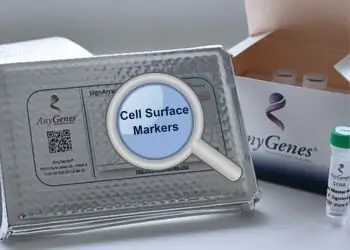
AnyGenes SignArrays® for comprehensive analysis of cell surface markers, enabling high-throughput research across human, mouse, rat, and pig species.

Cell surface marker profiles can be efficiently assessed by measuring gene expression of lineage-associated markers, activation-related molecules, adhesion proteins, and cell-type-specific transcriptional signatures. Such expression profiling supports precise characterization of cellular identity, functional states, and phenotypic heterogeneity across immune, stromal, and tumor-associated cell populations..

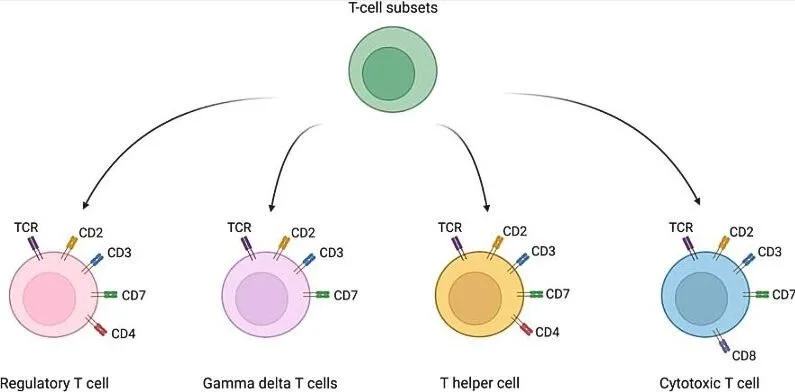
Detailed representation of T cell surface markers, including CD3, CD4, and CD8, for immune response research and differentiation of T cell subsets.
Differentiation of T-cell subsets and their respective cell surface marker (graphic from Gosmann D, et al. 2022).

Key Takeaways

  • Essential tools for cell identification and classification
  • Widely used in immunology, oncology, and stem cell research
  • Involved in signaling pathways regulating cell behavior
  • Strong relevance as biomarkers in disease and therapy
  • Suitable for gene expression-based profiling approaches

Key cell surface markers and applications

Immune cell markers:

T cell: CD3D, CD4, CD8A
B cell: CD19, CD79A, MS4A1

Innate and myeloid markers: CD163, CSF1R, FCGR1A

Endothelial and adhesion markers: PECAM1, VCAM1, ICAM2

Cancer-associated markers: EPCAM, KRT8, KRT18

Stem cell and stromal markers: NT5E (CD73), ENG

These marker categories collectively reflect immune cell identity, activation states, tissue-specific phenotypes, and tumor-associated profiles.

Molecular and functional roles of cell surface markers

Cell surface markers are not limited to passive identification. Many act as receptors or co-receptors that actively regulate intracellular signaling pathways.

Markers such as CD4 and CD8 participate in T cell receptor (TCR) signaling, modulating immune activation. Others, including EGFR and PD-1/PD-L1, influence tumor progression, immune evasion, and therapeutic response.

These molecules often function at the interface between extracellular signals and intracellular pathways, integrating environmental cues into coordinated cellular responses.

Related signaling pathways

  • T cell receptor (TCR) signaling
  • NF-κB signaling pathway
  • JAK-STAT signaling pathway
  • EGFR signaling pathway
  • Adhesion and integrin signaling pathways

Cell surface marker analysis: biomarkers and gene expression signatures

Gene expression analysis provides a robust and scalable approach to study cell surface markers beyond protein-level detection, enabling high-throughput and quantitative profiling across complex biological samples.

The panel integrates immune cell markers, antigen presentation molecules, adhesion proteins, and tumor-associated markers, providing a comprehensive view of cell identity and functional states.

This transcriptional approach complements protein-level analyses such as flow cytometry, enabling scalable and multiplexed investigation of cell surface marker expression.

Example biomarkers

CD3D, CD4, CD8A, CD19, CD34, EPCAM, PDCD1 (PD-1), CD274 (PD-L1)…

Biological functions in cell surface marker analysis

  • Cell lineage definition and phenotypic characterization
  • Regulation of immune responses
  • Control of cell proliferation and differentiation
  • Mediation of cell–cell interactions
  • Contribution to tumor progression and immune escape

Disease Relevance

Cancer

Surface markers are widely used to classify tumor subtypes and identify therapeutic targets, including immune checkpoint molecules.

Immunological disorders

Altered expression of immune markers can reflect dysregulated immune activation and chronic inflammation.

Stem cell biology

Markers are essential for identifying stem cell populations and monitoring differentiation processes.

Therapeutic Relevance

  • Targeting surface markers with monoclonal antibodies
  • Immune checkpoint inhibition (PD-1 / PD-L1)
  • CAR-T cell therapies
  • Patient stratification and precision medicine

Why perform cell surface marker analysis with AnyGenes®

AnyGenes® develops and customizes SignArrays® qPCR panels for cell surface marker analysis, enabling:

  • High-throughput gene expression profiling
  • Accurate quantification of biomarker signatures
  • Reproducible and standardized datasets
  • Multi-condition comparative analysis

Biomarker Analysis with AnyGenes®

AnyGenes® develops and customizes qPCR panels for cell surface marker analysis, integrating:

  • Curated gene sets covering immune, cancer, and stem cell markers
  • Multi-species compatibility (human, mouse, rat, pig)
  • Flexible panel design adapted to specific experimental workflows

Analyze your pathway data with AnyGenes® software

Scientific data is only as powerful as the analysis behind it.

AnyGenes® provides a dedicated data analysis tool specifically developed for SignArrays® pathway panels.

What does it allow you to do?

  • Automated ΔCq calculation
  • Normalization with selected housekeeping genes
  • Comparison of up to 10 experimental conditions
  • Generation of descriptive statistics
  • Publication-ready graphs
  • Exportable tables for manuscripts and presentations

Developed on Excel (compatible with 2007+), the software is user-friendly and requires no advanced bioinformatics skills.

Customize your own signaling pathways (SignArrays®) with the factors of your choice!
Simply download and complete our Personalized SignArrays® information file and send it at [email protected] to initiate your project.

Frequently asked questions

What are cell surface markers used for in research and clinical studies?

They are used to identify and classify cell types, particularly in immunology, oncology, and stem cell research.

Can cell surface markers be analyzed by gene expression?

Yes, qPCR-based approaches allow indirect but scalable analysis of marker expression profiles.

Why are surface markers important in immunotherapy?

They serve as therapeutic targets and help predict treatment response.

What is the advantage of qPCR over flow cytometry?

qPCR enables high-throughput, quantitative, and multiplexed analysis across many genes.

Are cell surface markers species-specific?

Some are conserved, but expression patterns can vary across species.

Cellular surface markers biomarker list

You can check the biomarker list included in this pathway, see below:

Looking for more answers? Visit our Help & FAQ section to find detailed informations about our products, services, and technical support.

Bibliography

1. Fonseca LN, et al. Cell surface markers for mesenchymal stem cells related to the skeletal system: A scoping review. Heliyon. (2023)10;9(2):e13464.

2. Gosmann D, et al. Promise and challenges of clinical non-invasive T-cell tracking in the era of cancer immunotherapy. EJNMMI Res. (2022)31;12:5.

3. Meyfour A, et al. The quest of cell surface markers for stem cell therapy. Cell Mol Life Sci. (2021) ;78(2):469-495.

Need pricing information or distributor details?
For quotations, product information, or project discussions, please contact our team at [email protected].