Hi, Continue visiting your profile
user

Login

Email

Password

Create account
Forget password
AnyGenes
  • email login

LncRNA qPCR challenges and how to overcome them

LncRNA qPCR challenges are a major concern in gene expression studies, especially when analyzing low-abundance and complex transcripts.

Despite its widespread use, qPCR analysis of long non-coding RNAs (lncRNAs) often leads to inconsistent results due to specificity issues, transcript variability, and experimental limitations.

Understanding these lncRNA qPCR challenges and applying appropriate solutions is essential to ensure accurate and reproducible results

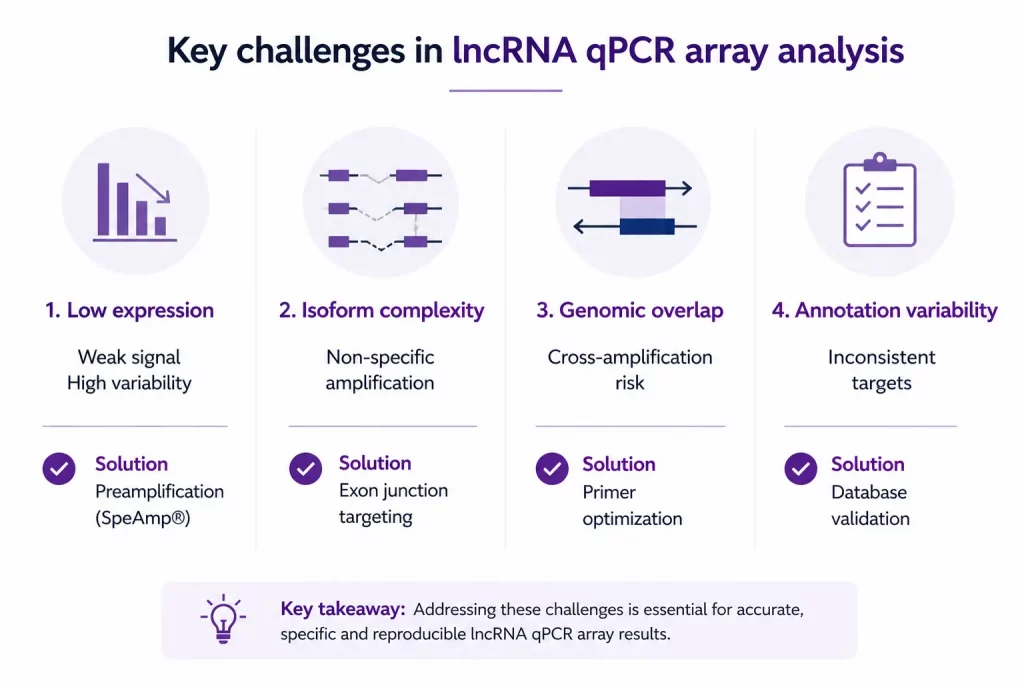
Infographic showing major challenges in lncRNA qPCR analysis including low expression levels, isoform complexity, genomic overlap, and annotation variability, with solutions to improve specificity and reproducibility.

Why lncRNA analysis is more complex than coding genes

Compared to protein-coding genes, lncRNAs present unique analytical difficulties:

  • Low abundance
  • Multiple isoforms
  • Genomic overlap
  • Variable annotation

These factors explain why these challenges are more frequent and harder to resolve.

Challenges related to low-expression lncRNAs

Many lncRNAs are expressed at very low levels, leading to:

  • Weak amplification signals
  • Increased variability
  • Reduced reproducibility

Solutions:

  • Use sensitive assays
  • Optimize qPCR conditions
  • Increase RNA input

For very low-expression lncRNAs, preamplification strategies such as SpeAmp® can significantly improve detection sensitivity, especially when working with limited RNA input or complex samples

Specificity and isoform-related challenges in lncRNA qPCR

LncRNAs often have multiple transcript variants, which can:

  • Cause non-specific amplification
  • Distort expression data

Solutions:

  • Target exon-exon junctions
  • Avoid conserved regions
  • Use validated assays

Challenges related to genomic overlap in lncRNA analysis

Some lncRNAs overlap with protein-coding genes, increasing the risk of:

  • Cross-amplification
  • False-positive signals

Solutions:

  • Careful primer design
  • gDNA removal
  • Experimental validation

How to overcome these challenges and improve qPCR reliability

To ensure robust results:

  • Use experimentally validated assays
  • Optimize primer design
  • Validate assay efficiency
  • Apply proper normalization

These practices are essential to overcome lncRNA qPCR challenges.

Reliable solutions for lncRNA qPCR challenges with AnyGenes

AnyGenes develops experimentally validated lncRNA qPCR assays designed for high specificity and reliable detection of low-expression transcripts, based on proprietary assay design and extensive expertise in complex RNA analysis.

Common mistakes that increase lncRNA qPCR challenges

Avoid these frequent issues:

  • Using non-validated primers
  • Ignoring isoform specificity
  • Poor normalization
  • Lack of replicates

Expert insight on lncRNA qPCR challenges

LncRNA qPCR analysis requires a more rigorous approach than standard gene expression studies.

For low-abundance and complex transcripts, validated assays and optimized workflows are essential to ensure specificity and reproducibility.

Key takeaways

  • lncRNA qPCR analysis presents unique challenges
  • low expression and isoform complexity affect accuracy
  • validated assays improve specificity and reproducibility
  • optimized workflows are essential

Frequently asked questions

Why is lncRNA qPCR difficult?

Because lncRNAs are often lowly expressed and have complex transcript structures.

How to improve lncRNA qPCR specificity?

By using validated primers, targeting exon junctions, and optimizing assay conditions.

What is the biggest challenge in lncRNA qPCR?

Low expression levels combined with isoform complexity.

What is the main challenge in lncRNA RNA-seq validation?

Low expression levels and transcript complexity.

Scientific references

  1. Mercer TR, Dinger ME, Mattick JS. Long non-coding RNAs: insights into functions. Nat Rev Genet. (2009) Mar;10(3):155-9. doi: 10.1038/nrg2521.
  2. Wang KC, Chang HY. Molecular mechanisms of long noncoding RNAs. Mol Cell. (2011) Sep 16;43(6):904-14. doi: 10.1016/j.molcel.2011.08.018.
  3. Bustin SA, Benes V, Garson JA, et al. The MIQE guidelines: minimum information for publication of quantitative real-time PCR experiments. Clin Chem. (2009) Apr;55(4):611-22. doi: 10.1373/clinchem.2008.112797.
  4. ENCODE Project Consortium. An integrated encyclopedia of DNA elements in the human genome. Nature. (2012) Sep 6;489(7414):57-74. doi: 10.1038/nature11247.

Need support for your lncRNA qPCR project?

Whether you are facing specificity issues or low-expression detection challenges, AnyGenes provides validated solutions tailored to your research needs.

Contact our team to discuss your project.